
Insight
Raleigh, NC: 8,300 residents of Indian descent; four in five of our set at $1M–5M
Raleigh's Asian Indian community grew 18% to about 8,300. Our database places 139 people there at $1M+, 108 of them in the $1M–5M band.
Raleigh has about 8,300 residents of Asian Indian descent, up 18% from about 7,000 in the 2015–2019 survey [1][2]. In a city of 481,000, that is 1.7% of residents [1][3].
Our database places 139 people in Raleigh at an estimated $1M+; 108 of them are in the $1M–5M band, about four in five (our calculation) [6].
- 8,258 residents of Asian Indian descent (alone or in combination) in Raleigh, North Carolina, 2020–2024 average [1], or 1.7% of the population [3].
- +18.2% versus the 2015–2019 estimate of 6,987 [1][2] (our calculation).
- 139 people in the HeyAlbert database placed in Raleigh, North Carolina at an estimated $1M+, of whom 31 are in our $5M+ bands [6].
How Raleigh compares with nearby places
The Census Bureau's American Community Survey counts 8,258 people who report Asian Indian ancestry, alone or with another group, in Raleigh [1], against 6,987 in 2015–2019 [2]. The table compares it with the places in Wake County that have the largest Asian Indian communities. Figures are for whole places, and some places extend into neighboring counties [1][2][4].
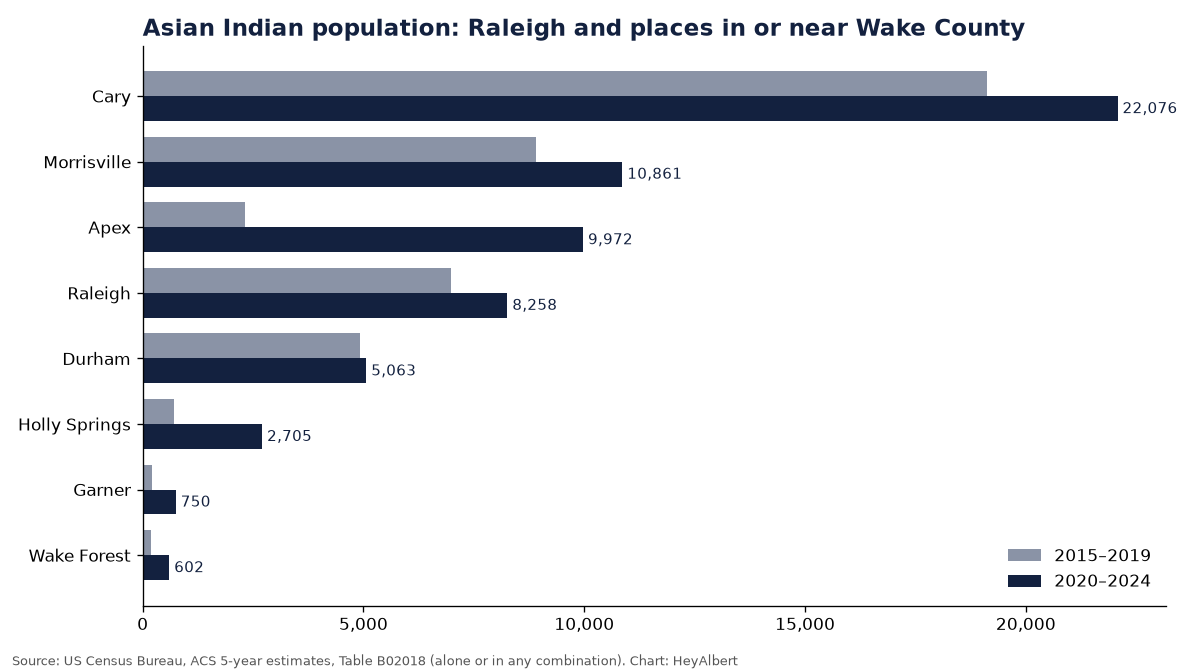
| Place | 2020–2024 | 2015–2019 | Change | Share of place |
|---|---|---|---|---|
| Cary | 22,076 | 19,119 | 15% | 12.3% |
| Morrisville | 10,861 | 8,897 | 22% | 34.6% |
| Apex | 9,972 | 2,320 | 330% | 14.1% |
| Raleigh | 8,258 | 6,987 | 18% | 1.7% |
| Durham | 5,063 | 4,927 | 3% | 1.7% |
| Holly Springs | 2,705 | 719 | 276% | 6.0% |
| Garner | 750 | 219 | 242% | 2.2% |
| Wake Forest | 602 | 181 | 233% | 1.1% |
Asian Indian alone or in any combination. Sources: ACS 5-year estimates [1][2][4]; totals from Table B01003. Change and share are our calculations. Estimates carry margins of error.
Raleigh is the state capital, but in the Wake County table it has a smaller community than Cary at 22,100, Morrisville at 10,900 or Apex at 10,000 [1][2][4]. Morrisville is 35% Asian Indian; Apex more than quadrupled in five years [1][2][4][1][2][4].
The most concentrated communities
Raw counts favor big cities. Ranking places of 20,000+ residents by the share who report Asian Indian ancestry gives a different map [1][2][3][4][5]:
| Place | Asian Indian residents | Total population | Share |
|---|---|---|---|
| Morrisville | 10,861 | 31,422 | 34.6% |
| Apex | 9,972 | 70,630 | 14.1% |
| Cary | 22,076 | 179,306 | 12.3% |
| Holly Springs | 2,705 | 45,248 | 6.0% |
| Durham | 5,063 | 291,467 | 1.7% |
| Raleigh | 8,258 | 481,031 | 1.7% |
Places with 20,000+ residents and at least 1,000 Asian Indian residents. CDP = census-designated place. Sources: ACS 2020–2024 5-year, Tables B02018 and B01003 [1][2][3][4][5]; shares are our calculation.
What the HeyAlbert database shows in Raleigh, North Carolina
HeyAlbert builds profiles of Indian-American individuals with an estimated net worth of $1M or more from public records, and every estimate is tied to a cited source. Our database currently places 139 such people in Raleigh, North Carolina [6]. That is a count of people we have found and estimated, not a census of wealthy households: our coverage is partial and uneven.
| Estimated net-worth band | People in our database |
|---|---|
| $5M+ | 31 |
| $1M–5M | 108 |
| Total, $1M+ | 139 |
Source: HeyAlbert database [6]. Bands are estimates from public evidence; $5M+ combines our $5–15M and $25M+ tiers. Cells under 25 are suppressed.
| City | $1M+ | of which $5M+ |
|---|---|---|
| Raleigh | 139 | 31 |
Source: HeyAlbert database [6]. Cities with 25+ people at $1M+; cells under 25 shown as <25. The city is where our sources place the person; for some records it is a workplace rather than a home. Our records are matched on the city name Raleigh; the Census figures are for the whole place.
Of the 139 people in our Raleigh set, 108 are in the $1M–5M band and 31 in our $5M+ bands [6]. Fewer than 25 have a public giving signal [6].
Why our Raleigh, North Carolina count looks the way it does
Each estimate in our database rests on a primary piece of public evidence. The mix differs from place to place, depending on which records we have been able to process, and it shapes the counts above more than any real difference in wealth does [6].
| Primary evidence for the estimate | People | Share |
|---|---|---|
| Home value (public assessor or listing records) | 105 | 76% |
| Other public signals (executive roles, company filings, gifts, pay) | 34 | 24% |
Source: HeyAlbert database [6], people at $1M+. Categories under 25 not shown.
Home values support 105 estimates and other public signals 34 [6]. A home-value-led set leans toward the $1M–5M band.
What it means if you work with these families
For advisors, Raleigh is a $1M–5M homeowner market inside a fast-growing county whose center is in the western suburbs [1][1][2][4][6]. Our Wake County and North Carolina posts cover the Triangle.
Methodology
Census figures are American Community Survey 5-year estimates for 2020–2024 and 2015–2019, Table B02018, using “Asian Indian, alone or in any combination” [1][2]. Total population comes from Table B01003 [3]. The Census Bureau changed how it codes detailed race responses in 2020, so part of the change between the two periods may reflect coding rather than migration. All estimates carry margins of error. Shares and growth rates are our calculations.
HeyAlbert counts are aggregates from our database as of November 2, 2026 [6]. They include people we identified as likely of Indian origin with an estimated net worth of $1M or more, based on public records such as property assessments, professional licenses, patents, SEC filings and donor rolls. Coverage is partial and depends on which public records exist and which we have processed. These counts are not population totals. Any cell under 25 is suppressed, and we publish aggregates only, never individual records.
Related
- Wake County: Morrisville is 35% Asian Indian, and the community grew 44%
- Indian-American wealth in North Carolina: the Triangle's young wealth
HeyAlbert finds Indian-American families worth $1M+ and tells you who to call, with every fact cited. See who is in Raleigh, North Carolina at heyalbert.site.
Sources
- ACS 2020–2024 5-year estimates, Table B02018, places in North Carolina. US Census Bureau. https://data.census.gov/table/ACSDT5Y2024.B02018?g=040XX00US37$1600000 (data: machine-readable)
- ACS 2015–2019 5-year estimates, Table B02018, places in North Carolina. US Census Bureau. https://data.census.gov/table/ACSDT5Y2019.B02018?g=040XX00US37$1600000 (data: machine-readable)
- ACS 2020–2024 5-year estimates, Table B01003 (total population), places in North Carolina. US Census Bureau. https://data.census.gov/table/ACSDT5Y2024.B01003?g=040XX00US37$1600000 (data: machine-readable)
- ACS 2020–2024 5-year estimates, Table B02018, places in Wake County, North Carolina. US Census Bureau. https://data.census.gov/table/ACSDT5Y2024.B02018?g=050XX00US37183$1600000 (data: machine-readable)
- ACS 2020–2024 5-year estimates, Table B01003, places in Wake County, North Carolina. US Census Bureau. https://data.census.gov/table/ACSDT5Y2024.B01003?g=050XX00US37183$1600000 (data: machine-readable)
- HeyAlbert database, aggregate counts (snapshot as of November 2, 2026); how we build it is described on our methodology page. HeyAlbert. https://heyalbert.site/research/methodology/
See the data before you talk to us
Read a full sample report to judge the depth and sourcing, then book a walkthrough with your own use case.