
Short answer
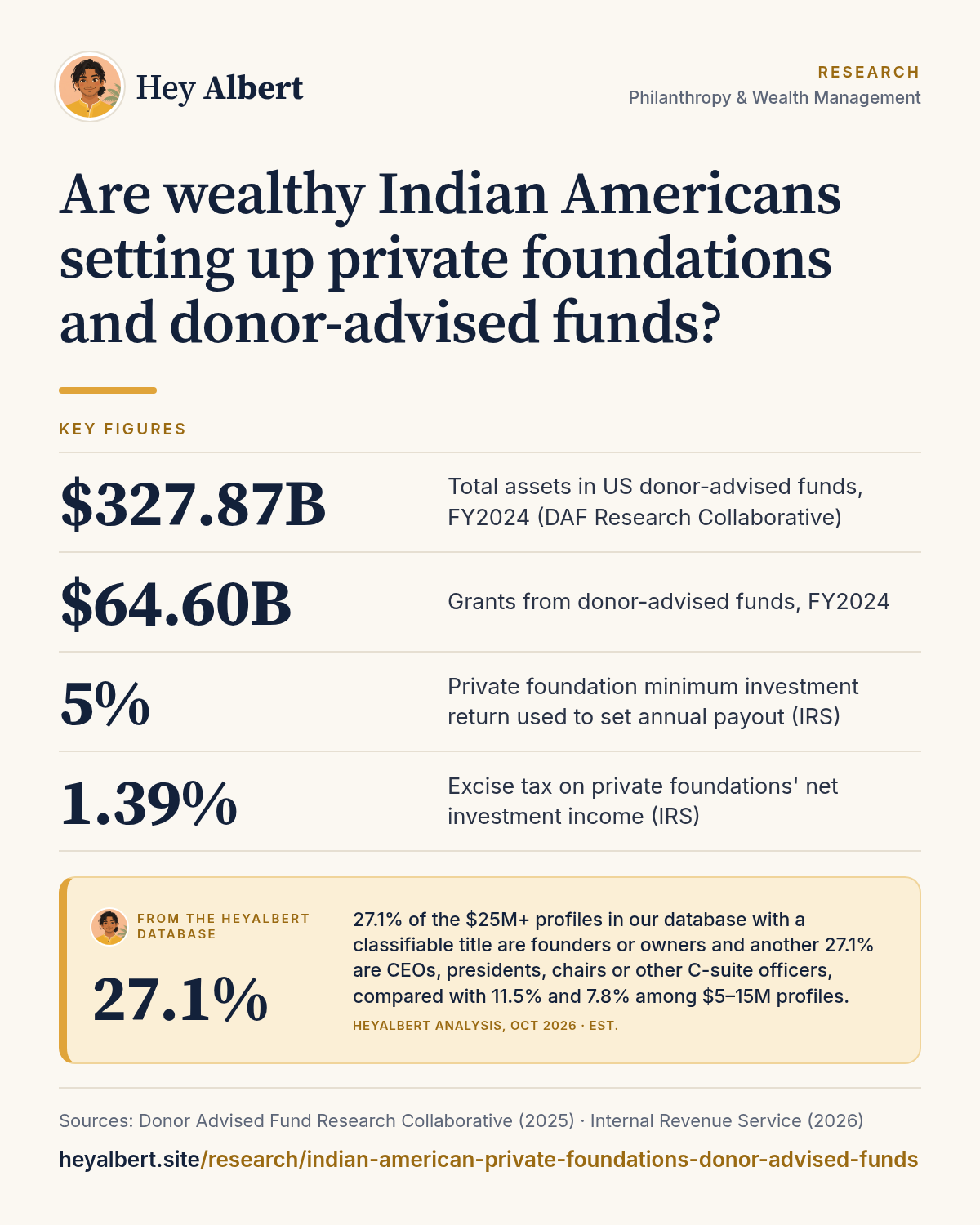
Yes. Several prominent Indian American founders and investors have created private foundations and publicly committed to giving away most of their wealth, including Vinod and Neeru Khosla and Manoj Bhargava, who signed the Giving Pledge in 2011 and 20121,2. No public data set tracks foundations or donor-advised funds by the donor's ethnicity, but both vehicles are growing fast nationally: DAF assets reached $327.87 billion in fiscal 20243.
HeyAlbert data shows 27.1% of the $25M+ profiles in our database with a classifiable title are founders or owners and another 27.1% are CEOs, presidents, chairs or other C-suite officers, compared with 11.5% and 7.8% among $5–15M profiles. See the data · Methodology
The short answer
Wealthy Indian American families use the same charitable vehicles as other high-net-worth Americans: private foundations, donor-advised funds (DAFs), and direct gifts to universities, hospitals and nonprofits. What is missing is a statistic. Neither the IRS nor the main DAF research groups report foundations or DAF accounts by the donor's ancestry, so any claim about how many Indian American foundations exist, or how much they hold, should be treated as an estimate at best.
The public record does show leading examples. Vinod and Neeru Khosla signed the Giving Pledge, a public commitment to give away the majority of one's wealth, in 20111. Manoj Bhargava, founder of 5-Hour Energy, signed in 20122; his pledge letter says his foundation has adopted over 400 charities, from schools and hospitals to women's career education in rural India2. The Chronicle of Philanthropy reported that Bhargava and Romesh Wadhwani, founder of Symphony Technology Group, both born in India, were among the same group of new signers6. For the wider picture, see Indian American philanthropy and the richest Indian Americans.
What HeyAlbert data shows
How a private foundation works
A private foundation is a separate charitable entity, usually funded by one family, that makes grants and sometimes runs its own programs. It gives the family control over investments, grantmaking and governance, and a lasting family name, but comes with rules:
- Annual payout: a non-operating private foundation must distribute a minimum amount each year, based on a minimum investment return of generally 5% of the fair market value of its noncharitable-use assets4
- Penalty for under-distribution: a 30% excise tax on undistributed income, with an additional 100% tax if it is not corrected7
- Investment income tax: a single 1.39% excise tax on net investment income for tax years beginning after December 20, 20195
- Public disclosure: foundations file Form 990-PF, which is publicly available
Foundations suit families who want to involve children and grandchildren in giving over generations, a theme in intergenerational wealth transfer among Indian Americans.
How a donor-advised fund works
A DAF is an account held at a sponsoring charity, such as a community foundation or the charitable arm of a financial firm. The donor gets a tax deduction when contributing and recommends grants over time, but the sponsor legally controls the assets. DAFs are simpler and cheaper than foundations and offer more privacy.
They are growing quickly. According to the DAF Research Collaborative, which analyzes IRS Form 990 data, total DAF assets grew 27.9% to $327.87 billion in fiscal 2024; contributions rose 38.6% to $90.57 billion; grants rose 17.9% to $64.60 billion; and the average account size was $91,3003. Founders and executives often use DAFs to donate appreciated stock before or after a liquidity event, a link we explore in equity compensation for tech executives and the largest Indian American IPOs and exits.
Foundation or DAF?
| Private foundation | Donor-advised fund | |
|---|---|---|
| Control | Family board controls assets and grants | Sponsor controls; donor recommends |
| Payout rule | Annual minimum based on 5% of noncharitable assets4 | No federal minimum for individual accounts |
| Taxes | 1.39% excise tax on net investment income5 | None at the account level |
| Privacy | Form 990-PF is public | Grants can be made anonymously |
| Cost and setup | Legal entity, staff, filings | Opened in days at a sponsor |
Many wealthy families use both: a foundation for signature programs and a DAF for flexible or anonymous giving.
Cross-border giving
Many Indian American donors want to support causes in India. US tax rules generally require that a deductible gift go to a qualified US organization, so gifts for Indian causes often run through US public charities that fund work in India, or through a foundation that makes grants abroad under its own due-diligence rules. Indian rules on receiving foreign contributions add a further layer for the recipient organization. Donors with substantial assets in India also need to coordinate charitable plans with their estate plans; see cross-border estate planning.
Why it matters
For nonprofits, universities and advisors, foundations and DAFs are where much major giving now originates. Large university gifts from Indian American donors, which we track in the largest Indian American university gifts, often come from family foundations. And for families with an operating business or a family office, the choice of vehicle is part of a broader governance plan; see Indian American family offices.
Political contributions follow separate federal rules and are not tax-deductible charitable gifts; see how Indian Americans participate in political giving.
Frequently asked questions
Which Indian Americans have signed the Giving Pledge?
Public examples include Vinod and Neeru Khosla, who signed in 2011, and Manoj Bhargava, who signed in 2012. Romesh Wadhwani was reported among the same group of new signers as Bhargava.
What is the difference between a private foundation and a donor-advised fund?
A private foundation is a separate entity the family controls, with an annual payout requirement and a 1.39% tax on investment income. A donor-advised fund is an account at a sponsoring charity; the donor recommends grants but the sponsor controls the assets.
How much money is in donor-advised funds?
US donor-advised funds held $327.87 billion in fiscal 2024, according to the DAF Research Collaborative, with $64.60 billion in grants that year.
How many Indian American family foundations are there?
No reliable count exists, because the IRS and DAF researchers do not track donors by ethnicity. Public examples come from Giving Pledge signers, university gift announcements and foundation filings.
Sources
Figures are from the public sources below, with the data year stated. Estimates are labeled as estimates. Accessed October 24, 2026.
- The Giving Pledge, Vinod and Neeru Khosla (2026). givingpledge.org ↩ ↩ ↩
- The Giving Pledge, Manoj Bhargava (pledge letter) (2026). givingpledge.org ↩ ↩ ↩
- Donor Advised Fund Research Collaborative, Annual DAF Report (FY2024 data) (2025). dafresearchcollaborative.org ↩ ↩ ↩
- Internal Revenue Service, SOI Tax Stats – Private foundations study terms and concepts (2026). irs.gov ↩ ↩ ↩
- Internal Revenue Service, Tax on net investment income of private foundations (2026). irs.gov ↩ ↩ ↩
- The Chronicle of Philanthropy, With 11 New Members, 'Giving Pledge' Signers Now Number 92 (2012). philanthropy.com ↩
- Internal Revenue Service, Taxes on failure to distribute income – Private foundations (2026). irs.gov ↩