
Short answer
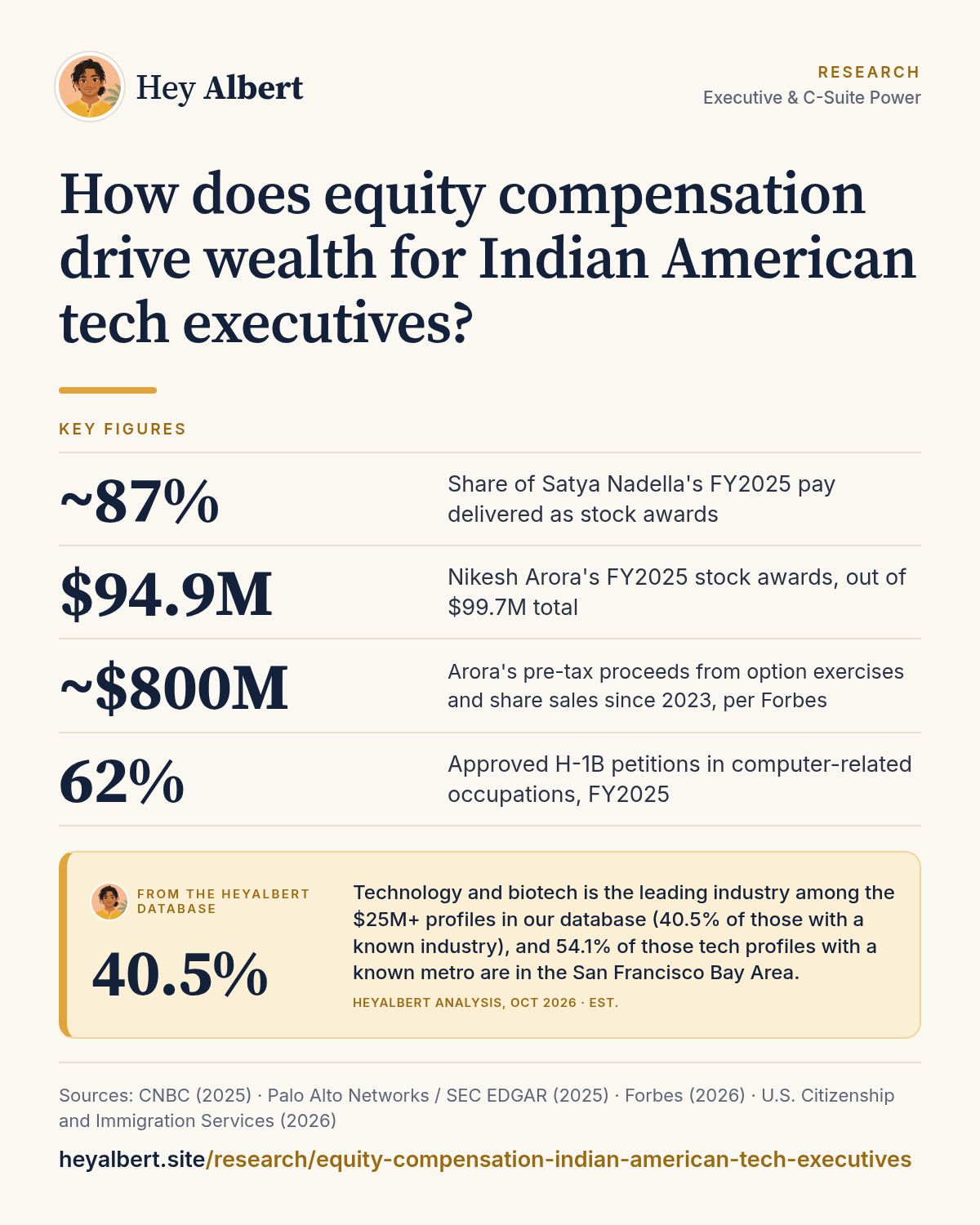
For senior tech executives, most pay comes as stock, so wealth tracks the share price. About 87% of Microsoft CEO Satya Nadella's $96.5 million fiscal 2025 pay was stock awards1. Nikesh Arora received $94.9 million of his $99.7 million in stock2. Forbes estimates Arora has netted nearly $800 million before tax from exercising options and selling shares since 20236. Indian Americans are heavily concentrated in technology occupations, so this mechanism accounts for much of the community's newer wealth9,10.
HeyAlbert data shows technology and biotech is the leading industry among the $25M+ profiles in our database (40.5% of those with a known industry), and 54.1% of those tech profiles with a known metro are in the San Francisco Bay Area. See the data · Methodology
Why stock, not salary, builds tech wealth
At large US technology companies, cash pay is capped and equity is not. Proxy filings show the pattern clearly. Nadella's fiscal 2025 package included more than $84 million in stock awards and over $9.5 million in cash incentives1. Arora's salary was $1 million, beside $94.9 million in stock awards2. Alphabet keeps Sundar Pichai's salary at $2 million, unchanged since 2020, and pays him mainly in equity granted every three years3. The same structure applies, at smaller scale, to vice presidents, directors and senior engineers. Many of them hold restricted stock units worth several times their salary.
That matters for Indian American wealth because the community is concentrated in exactly these roles. 62% of H-1B petitions approved in fiscal 2025 were for computer-related occupations, and 70% were for people born in India9. Indian immigrants are much more likely than other groups to work in management, business and science occupations10. Our breakdown of CEO pay and analysis of H-1B visas and wealth add detail.
What HeyAlbert data shows
The main instruments
- Restricted stock units (RSUs). A promise of shares that vest over time, usually over several years. Pichai's 2026 award, for example, vests monthly through January 20293.
- Performance stock units (PSUs). Shares that vest only if targets are met. Alphabet's PSUs for Pichai depend on total shareholder return against S&P 100 companies and can vest at 0% to 200% of target3.
- Stock options. The right to buy shares at a fixed price. The IRS distinguishes statutory options (incentive stock options and employee stock purchase plans) from nonstatutory options7.
- Founder equity. Shares held from a company's founding. It is the largest source of wealth for founders such as Jay Chaudhry, whose family holds around 35% of Zscaler, per Forbes11.
How it is taxed
Tax treatment drives many planning decisions. Under the IRS restricted-property rules, stock received for services is generally taxed as income when it becomes substantially vested. The taxable amount is its fair market value minus anything paid for it12. Under IRS rules, a nonstatutory option with no readily determinable market value is not taxed when granted. When it is exercised, the difference between the stock's fair market value and the price paid counts as income, and a later sale produces a capital gain or loss7. Statutory options are generally not included in income at grant or exercise. Exercising an incentive stock option can trigger the alternative minimum tax, though7. Executives with large positions often face concentrated-stock risk and large tax bills at the same time. That is why diversification, charitable giving of appreciated stock and family-office structures appear early in planning. Cross-border families have additional reporting requirements, covered in our guide to FBAR, FATCA and the US-India tax treaty.
Selling: plans, windows and timing
Senior executives cannot simply sell when they like. Many use pre-arranged trading plans under SEC Rule 10b5-1. In 2022 the SEC added cooling-off periods before trading can start under such plans, and required that plans be entered into in good faith8. For relationship managers and advisers, scheduled vesting dates, plan adoptions and lock-up expiries after an IPO are the moments when paper wealth turns into cash. Arora's roughly $800 million in pre-tax proceeds since 2023 came through exactly these mechanisms6.
Timing affects the tax bill as well as the proceeds. Under IRS rules, the gain on shares sold after exercise or vesting is generally treated as a capital gain or loss7. Holding periods therefore change the tax rate, and executives and their advisers often plan sales around them. The same calendar decides when a family has cash for a home, an angel investment or a major gift.
Ownership versus pay
The largest fortunes come from owning a company, not from being paid by one. Jayshree Ullal's reported 2025 pay at Arista Networks was $2.9 million4. Her roughly 2% stake underpins a Forbes estimate of about $6.7 billion5. Professional CEOs build wealth more slowly through repeated grants. Founders and very early employees can reach the top tier in a single liquidity event. Our ranking of the richest Indian Americans and our list of the largest founder exits show both routes.
What it means for household wealth
Equity-heavy pay makes tech households wealthier on paper and more exposed to a single stock. Many diversify into real estate, index funds and private investments over time, and some start angel investing. Our research on how Indian Americans invest, on angel investing through networks such as TiE and on family offices follows that money.
Frequently asked questions
How much of a tech CEO's pay is stock?
Usually most of it. About 87% of Satya Nadella's fiscal 2025 pay was stock awards, and about 95% of Nikesh Arora's.
How are RSUs and stock options taxed?
Under IRS rules, stock received for services, such as vested RSUs, is generally taxed as income when it becomes substantially vested. Nonstatutory options are usually taxed on the spread at exercise, with capital gain or loss on sale. Incentive stock options generally are not taxed at exercise but can trigger the alternative minimum tax.
Why do executives sell stock on a schedule?
Many use SEC Rule 10b5-1 trading plans, which since 2022 require cooling-off periods and good faith, to sell shares without insider-trading concerns.
Do founders or executives get richer from equity?
Founders with large stakes usually do. Jayshree Ullal's reported pay is about $2.9 million a year, while her Arista stake underpins a fortune of about $6.7 billion.
Sources
Figures are from the public sources below, with the data year stated. Estimates are labeled as estimates. Accessed October 24, 2026.
- CNBC, Microsoft CEO Satya Nadella's total comp rises to $96.5 million (2025). cnbc.com ↩ ↩ ↩
- Palo Alto Networks / SEC EDGAR, Palo Alto Networks 2025 proxy statement (DEF 14A), Summary Compensation Table (2025). sec.gov ↩ ↩ ↩
- Alphabet / SEC EDGAR, Alphabet Form 8-K, March 4, 2026 (CEO compensation) (2026). sec.gov ↩ ↩ ↩
- Arista Networks / SEC EDGAR, Arista Networks 2026 proxy statement (DEF 14A), Summary Compensation Table (2026). sec.gov ↩
- Forbes, Jayshree Ullal profile (real-time net worth) (2026). forbes.com ↩
- Forbes, Nikesh Arora profile (2026). forbes.com ↩ ↩ ↩
- Internal Revenue Service, Topic no. 427, Stock options (2026). irs.gov ↩ ↩ ↩
- US Securities and Exchange Commission, SEC Adopts Amendments to Modernize Rule 10b5-1 Insider Trading Plans and Related Disclosures (Press Release 2022-222) (2022). sec.gov ↩
- US Citizenship and Immigration Services, Characteristics of H-1B Specialty Occupation Workers, Fiscal Year 2025 Annual Report to Congress (2026). uscis.gov ↩ ↩ ↩
- Migration Policy Institute, Indian Immigrants in the United States (2026). migrationpolicy.org ↩ ↩
- Forbes, Jay Chaudhry profile (real-time net worth) (2026). forbes.com ↩
- Internal Revenue Service, Publication 525, Taxable and Nontaxable Income (Restricted Property) (2026). irs.gov ↩