
Short answer
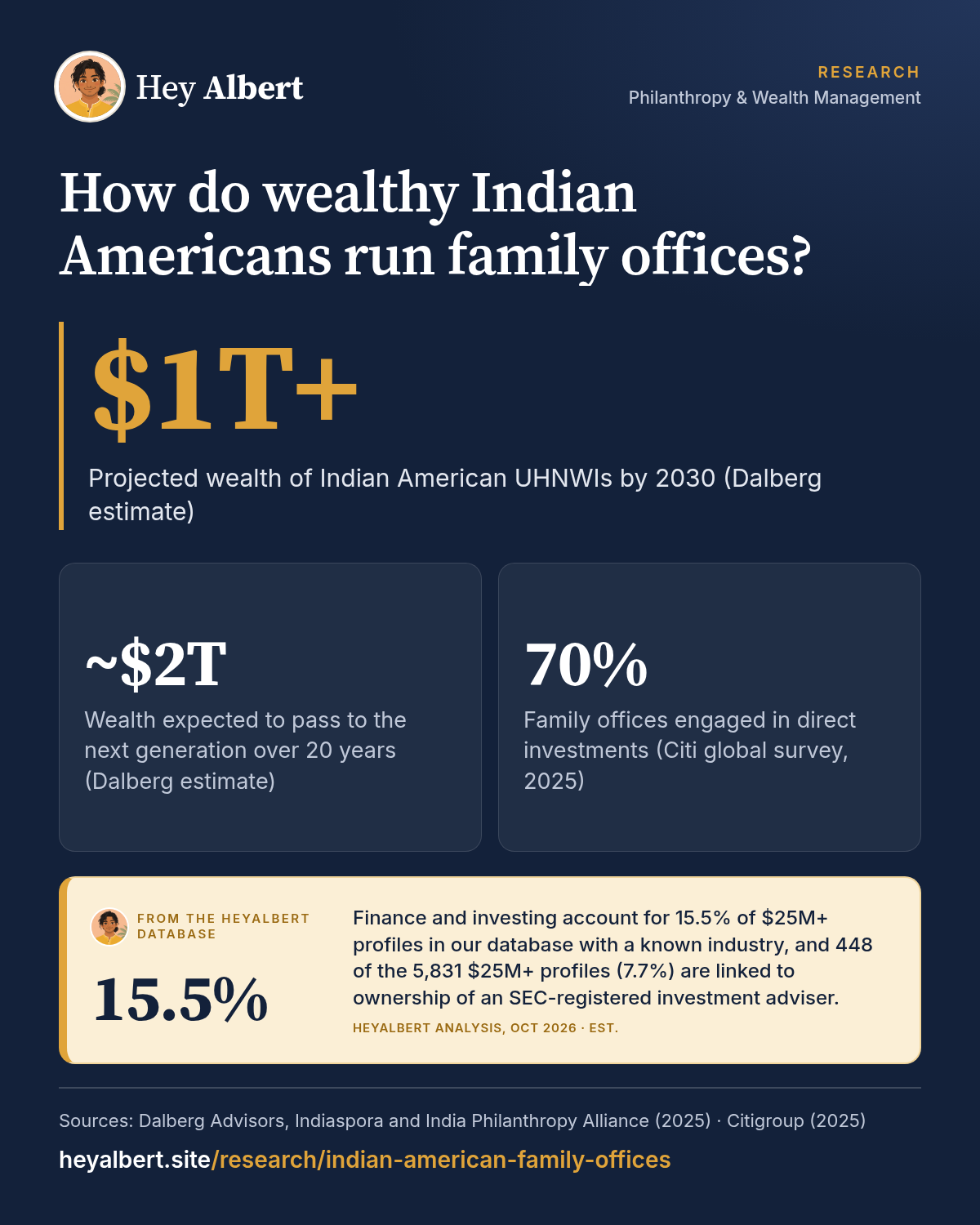
Wealthy Indian American families typically set up a single-family office after a liquidity event, such as an IPO or company sale. They use it to manage investments, direct deals, philanthropy and succession in one place. Dalberg projects that Indian American ultra-high-net-worth individuals will hold more than $1 trillion by 20301. Under SEC rules, a qualifying single-family office that advises only family clients is excluded from regulation as an investment adviser2.
HeyAlbert data shows finance and investing account for 15.5% of $25M+ profiles in our database with a known industry, and 448 of the 5,831 $25M+ profiles (7.7%) are linked to ownership of an SEC-registered investment adviser. See the data · Methodology
What a family office is
A family office is a private company that manages a wealthy family's investments and affairs. A single-family office serves one family. A multi-family office serves several. In the US, the SEC's family office rule excludes a single-family office from regulation as an investment adviser if it meets three conditions: it advises only "family clients", it is wholly owned by family clients and controlled by family members or family entities, and it does not present itself to the public as an investment adviser2. The rule defines family members broadly: all lineal descendants of a common ancestor up to 10 generations back, including by adoption, and their spouses or spousal equivalents. Certain key employees of the office can also be clients2. That breadth suits large, multigenerational families. Our research on multigenerational living looks at how common those are among Indian Americans. The exclusion is one reason many founders set up a dedicated office instead of relying only on outside wealth managers.
Beyond investments, family offices typically handle tax planning, estate structures, philanthropy, real estate, insurance, reporting and family governance. Large families staff these functions in-house. Smaller offices outsource much of the work.
What HeyAlbert data shows
How Indian American family offices typically form
Most start with a liquidity event. A founder sells a company or takes it public, or an executive's equity becomes large enough to need full-time management. Our list of the largest Indian American IPOs and exits shows where much of that liquidity came from. Some offices grow out of an investment firm. Ranjan Tandon's hedge fund Libra Advisors, founded in 1990, was later converted into a family office, according to NYU4. Kavitark Ram Shriram has invested in startups through his firm Sherpalo Ventures since 20005.
Philanthropy is often run beside the investment office. The Patel Family Foundation, for example, made a $200 million commitment to Nova Southeastern University in 20176. See our guide to private foundations and donor-advised funds.
What family offices invest in
No published survey isolates Indian American family offices. Global data shows the direction of travel. In Citi's 2025 survey of 346 family offices in 45 countries, 70% were engaged in direct investments, and four in ten of those had increased that activity over the past year3. Private equity saw the most positive allocation changes3. Respondents named global trade disputes (60%), US-China relations (43%) and a resurgence of inflation (37%) as top concerns3.
Indian American founders often bring two more features: a strong network for direct deals in technology, and ties to India that can extend to Indian startups, real estate and family businesses. Our research on angel networks such as TiE, on how Indian Americans invest and on property held in India covers these patterns.
Cross-border complexity
Many affluent Indian American families hold assets, relatives or businesses in two countries. That adds layers of reporting and planning. Citizenship status matters too. The Migration Policy Institute reports that 47% of Indian immigrants were US citizens in 20247, so many families include green-card holders or people on temporary visas, whose tax and estate rules differ. The issues include foreign account reporting, the US-India tax treaty and how inheritance works across both systems. Our guides to FBAR, FATCA and the US-India tax treaty and to cross-border estate planning go into detail.
Succession and the next generation
Succession is the defining challenge. Dalberg estimates that nearly $2 trillion will pass to the next generation of Indian Americans over the next two decades1. Citi's survey found that family offices worldwide still need to improve leadership succession planning, cybersecurity and operational risk management3. Next-generation members often bring different priorities. Dalberg found that nearly a quarter of next-generation Indian American respondents had never been asked to give to causes they care about. 24% were interested in giving circles, rising to 33% among next-generation women8. Our research on intergenerational wealth transfer looks at that shift.
Philanthropy as a family-office function
For many families, structured giving is a core purpose of the office. Several Indian American billionaires, including Romesh and Kathleen Wadhwani, Vinod and Neeru Khosla, and Bharat Desai and Neerja Sethi, have signed the Giving Pledge9. A family office usually coordinates the foundation, donor-advised funds and gifts of appreciated stock, and ties them to the family's tax and estate plans. Our overview of where wealthy Indian Americans give has the wider picture.
Frequently asked questions
What is a single-family office?
A private company that manages one wealthy family's investments and affairs. In the US, a qualifying single-family office that advises only family clients and is family-owned and controlled is excluded from SEC regulation as an investment adviser.
When do Indian American families set up family offices?
Usually after a liquidity event such as an IPO, a company sale or the vesting of a large equity position, when wealth becomes too complex to manage informally.
What do family offices invest in?
Globally, they hold public equities, private equity, real estate and direct stakes in private companies. In Citi's 2025 survey, 70% of family offices were engaged in direct investments.
What makes Indian American family offices different?
Cross-border assets and family ties to India, a mix of citizenship and immigration statuses, and strong networks for direct technology investments.
Sources
Figures are from the public sources below, with the data year stated. Estimates are labeled as estimates. Accessed October 24, 2026.
- Dalberg Advisors, Indiaspora and India Philanthropy Alliance, From Closing the Gap to Setting the Standard: The State of Philanthropic Giving in the Indian American Diaspora (2025). dalberg.com ↩ ↩ ↩
- US Securities and Exchange Commission, Family Office: A Small Entity Compliance Guide (2011). sec.gov ↩ ↩ ↩
- Citigroup, Citi Wealth Releases 2025 Global Family Office Report (2025). citigroup.com ↩ ↩ ↩
- NYU Tandon School of Engineering, Engineering Transformed (2015). engineering.nyu.edu ↩
- Forbes, Kavitark Ram Shriram profile (real-time net worth) (2026). forbes.com ↩
- Nova Southeastern University, Nova Southeastern University Receives $200 Million Commitment from Patel Family Foundation (2017). news.nova.edu ↩
- Migration Policy Institute, Indian Immigrants in the United States (2026). migrationpolicy.org ↩ ↩
- Dalberg Advisors, Indian American Philanthropy Narrows Giving Gap from $2–3 Billion to Just $1 Billion (press release) (2025). dalberg.com ↩
- The Giving Pledge, Pledger List (2026). givingpledge.org ↩