
Short answer
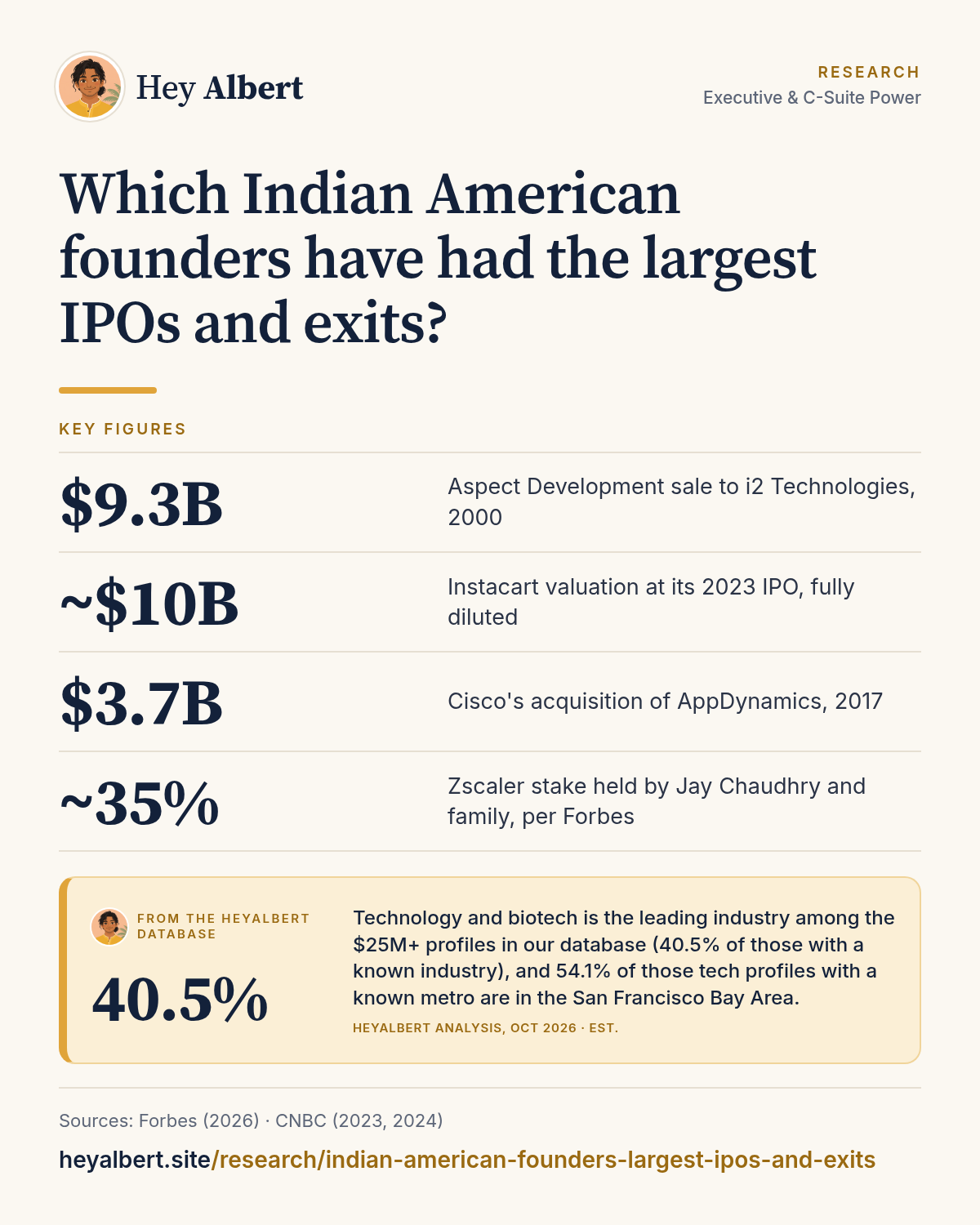
Among the largest are Romesh Wadhwani's Aspect Development, sold to i2 Technologies for $9.3 billion in 20001, and Confluent, cofounded by Neha Narkhede, which went public in 2021 at a $9.1 billion valuation2. Apoorva Mehta's Instacart went public in 2023 at about $10 billion3. Jyoti Bansal sold AppDynamics to Cisco for $3.7 billion in 20175. The biggest single fortune came from an IPO: Jay Chaudhry's Zscaler, which listed in 20187.
HeyAlbert data shows technology and biotech is the leading industry among the $25M+ profiles in our database (40.5% of those with a known industry), and 54.1% of those tech profiles with a known metro are in the San Francisco Bay Area. See the data · Methodology
The landmark exits
The table covers notable IPOs and acquisitions of companies founded or cofounded by Indian-born or Indian-origin entrepreneurs in the US, from sources we could verify. It is a selection, not a complete ranking. Values are at the time of the deal.
| Company | Founder(s) | Event | Year | Value |
|---|---|---|---|---|
| Aspect Development | Romesh Wadhwani | Acquired by i2 Technologies | 2000 | $9.3B1 |
| Instacart | Apoorva Mehta (cofounder) | IPO | 2023 | ~$10B valuation3 |
| Confluent | Neha Narkhede (cofounder) | IPO | 2021 | $9.1B valuation2 |
| AppDynamics | Jyoti Bansal | Acquired by Cisco | 2017 | $3.7B5 |
| Syntel | Bharat Desai, Neerja Sethi | Acquired by Atos | 2018 | $3.4B6 |
| Astera Labs | Jitendra Mohan, Sanjay Gajendra (cofounders) | IPO | 2024 | $713M raised8 |
| Zscaler | Jay Chaudhry | IPO | 2018 | Family stake ~35% today7 |
Founder origins are taken from the cited profiles. Wadhwani studied at IIT before his PhD at Carnegie Mellon1. Narkhede grew up in Pune2. Mehta was born in Jodhpur4. Bansal was born in India5. Mohan did his undergraduate degree in India11.
What HeyAlbert data shows
IPOs create the largest fortunes
An acquisition pays founders once. A founder who keeps a large stake through an IPO can see it compound for years. Jay Chaudhry founded Zscaler in 2008 and took it public in March 2018. Forbes estimates he and his family still own around 35% of the company, the main source of his roughly $14.5 billion fortune7. Before Zscaler he had founded and sold four security companies: SecureIT, CoreHarbor, CipherTrust and AirDefense7. Serial founding is a common pattern among the most successful entrepreneurs on this list.
Astera Labs followed a similar arc. Mohan and Gajendra cofounded the AI connectivity chipmaker in 2017 and listed it on Nasdaq in 2024, raising $713 million8,10. Both became billionaires and joined Forbes' 2026 list of America's richest immigrants9,11. Our ranking of the richest Indian Americans shows how many top fortunes trace back to a single IPO.
Acquisitions: earlier liquidity, often a second act
Selling to a strategic buyer gives founders and employees cash sooner. Bansal sold AppDynamics to Cisco in 2017 for $3.7 billion, shortly before its planned IPO. The deal made hundreds of employees wealthy. Bansal later described the day as his "saddest day" because he gave up the chance to keep building the company5. He went on to found new startups. Desai and Sethi built Syntel over nearly four decades before selling it to Atos for $3.4 billion in 2018. Forbes estimates Sethi alone received about $510 million6.
Wadhwani's 2000 sale of Aspect Development made him a billionaire, and he later founded SymphonyAI1. That founder-to-investor-to-founder cycle is a big part of the Indian American angel and early-stage investor network.
Timing: the same company, very different numbers
The value of an exit depends heavily on market conditions. Instacart raised money at a $39 billion valuation in early 2021. When it priced its IPO in September 2023, at the top of its range, it was valued at about $10 billion on a fully diluted basis3. It was the first notable venture-backed tech IPO in the US since December 2021. At the time of the IPO, Mehta, who had handed the CEO role to Fidji Simo in 2021, owned shares worth over $800 million3.
Confluent shows the opposite path. Narkhede helped build the open-source system Apache Kafka at LinkedIn, then cofounded Confluent with two colleagues in 2014. It went public in 2021 at a $9.1 billion valuation, and Forbes estimates she owns around 6%2. For founders, the date of a listing or sale, and the lock-ups that follow it, can matter as much as the business itself.
Early investors and executives also share in exits
Exits create wealth beyond the founders. Vinod Khosla cofounded Sun Microsystems in 1982. His firm, Khosla Ventures, later benefited from IPOs including Affirm and DoorDash12. Kavitark Ram Shriram was president of the comparison-shopping startup Junglee when Amazon bought it in 1998, and he became one of Google's earliest backers13. See our profiles of leading Indian American venture capitalists and how equity compensation spreads exit wealth to executives and early employees.
What happens after the exit
A liquidity event raises practical questions: lock-up periods, concentrated stock positions, taxes on large gains, and whether to diversify or reinvest. Many founders set up family offices, private foundations or donor-advised funds within a few years of an exit. Our guides to family offices and Indian American unicorn founders cover what usually follows. Liquidity events are also when the largest philanthropic gifts tend to be made.
Frequently asked questions
What is the largest exit by an Indian American founder?
Among verified deals, Romesh Wadhwani's sale of Aspect Development to i2 Technologies for $9.3 billion in 2000 is one of the largest acquisitions. Instacart's 2023 IPO, at about $10 billion, and Confluent's 2021 IPO, at $9.1 billion, are among the largest listings.
Which Indian American founder made the most from an IPO?
Jay Chaudhry, who took Zscaler public in 2018 and still holds a stake of around 35% with his family. Forbes valued him at about $14.5 billion in October 2026.
How much did Cisco pay for AppDynamics?
Cisco paid $3.7 billion for AppDynamics, founded by Jyoti Bansal, in 2017, shortly before the company's planned IPO.
Do founders usually sell or go public?
Both are common. IPOs have produced the largest lasting fortunes when founders kept big stakes, while acquisitions give earlier, more certain liquidity.
Sources
Figures are from the public sources below, with the data year stated. Estimates are labeled as estimates. Accessed October 24, 2026.
- Forbes, Romesh T. Wadhwani profile (real-time net worth) (2026). forbes.com ↩ ↩ ↩
- Forbes, Neha Narkhede profile (2025). forbes.com ↩ ↩ ↩
- CNBC, Instacart prices IPO at $30 a share (2023). cnbc.com ↩ ↩ ↩
- Wikipedia, Apoorva Mehta (2026). en.wikipedia.org ↩
- CNBC, AppDynamics founder: Why I regret selling my startup for billions (2024). cnbc.com ↩ ↩ ↩
- Forbes, Bharat Desai profile (real-time net worth) (2026). forbes.com ↩ ↩
- Forbes, Jay Chaudhry profile (real-time net worth) (2026). forbes.com ↩ ↩ ↩
- Wikipedia, Astera Labs (2026). en.wikipedia.org ↩ ↩
- Forbes, Jitendra Mohan profile (real-time net worth) (2026). forbes.com ↩
- Forbes, Sanjay Gajendra profile (real-time net worth) (2026). forbes.com ↩
- Mint, 19 of the richest immigrant billionaires in US were born in India (reporting Forbes' America's Richest Immigrants 2026) (2026). livemint.com ↩ ↩
- Forbes, Vinod Khosla profile (real-time net worth) (2026). forbes.com ↩
- Forbes, Kavitark Ram Shriram profile (real-time net worth) (2026). forbes.com ↩