
Short answer
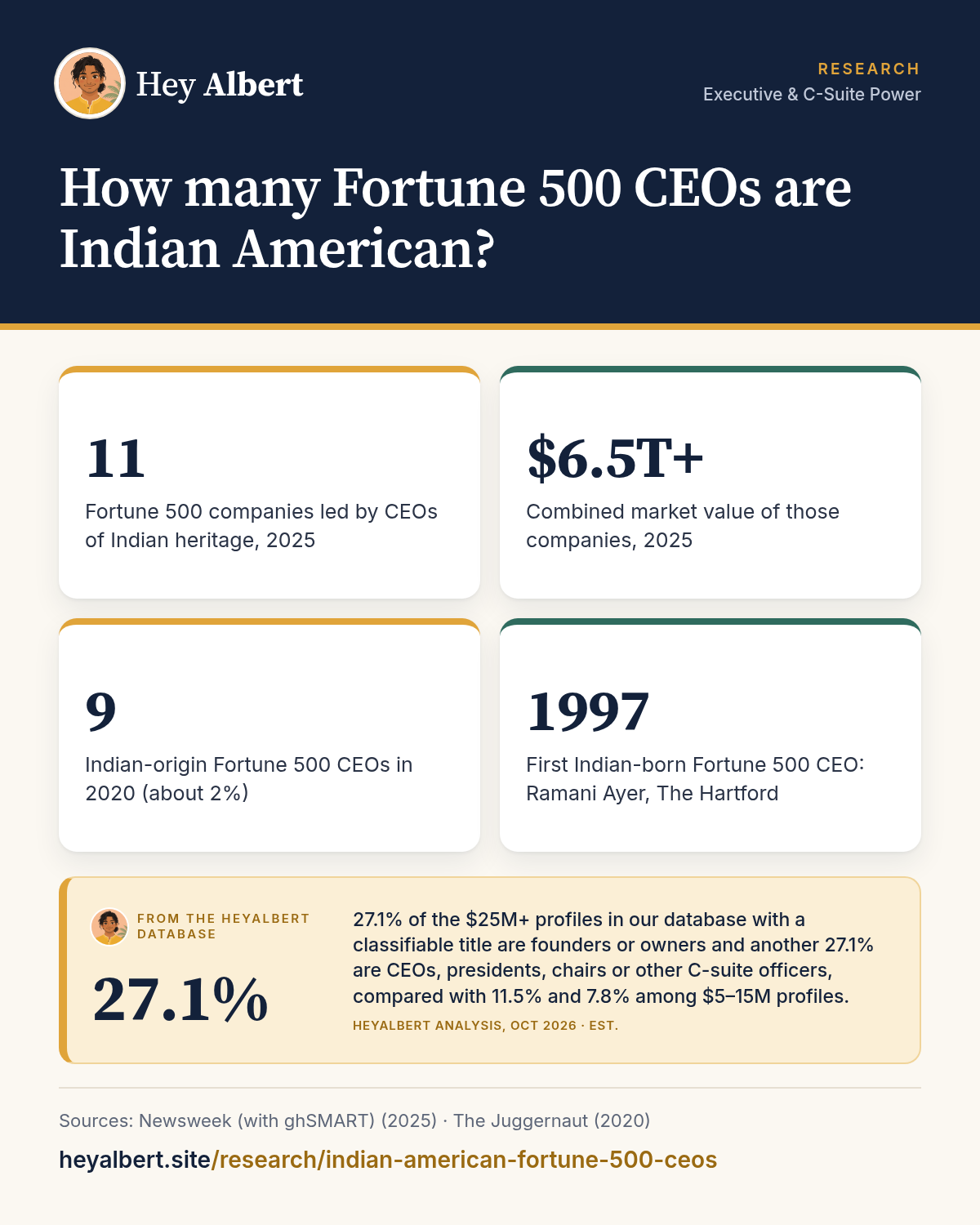
According to a 2025 Newsweek analysis with leadership advisers ghSMART, 11 companies on that year's Fortune 500 were led by CEOs of Indian heritage. Together they oversaw more than $6.5 trillion in market value1. That is about 2.2% of the list, against roughly 1.5% of the US population11,5.
HeyAlbert data shows 27.1% of the $25M+ profiles in our database with a classifiable title are founders or owners and another 27.1% are CEOs, presidents, chairs or other C-suite officers, compared with 11.5% and 7.8% among $5–15M profiles. See the data · Methodology
The count: about a dozen, and rising
Counts of Indian American Fortune 500 CEOs vary, because analysts draw the line differently. Some count only India-born executives. Others include anyone of Indian heritage, wherever they were born. The most rigorous recent tally is Newsweek's 2025 analysis with ghSMART. It found 11 companies on that year's Fortune 500 led by CEOs of Indian heritage, overseeing a combined market value of more than $6.5 trillion1,2. In 2020, The Juggernaut counted nine Indian-origin Fortune 500 CEOs, about 2% of the list3.
Some outlets give much higher figures, claiming as much as 30% of the Fortune 500. Those claims do not hold up against any published list. The defensible answer is about a dozen companies in 2025, or roughly 2% of the Fortune 500. That share has grown slowly as the first generation of Indian-born executives reached the top.
What HeyAlbert data shows
Who leads Fortune 500 companies
Newsweek's 2025 analysis named Satya Nadella at Microsoft, Sundar Pichai at Google and Raj Subramaniam at FedEx among the current leaders. It also named Leena Nair, who runs Chanel, a private company outside the Fortune 500. Laxman Narasimhan, who led Starbucks until 2024, was on the list too1. Company and Forbes records show other Indian-origin CEOs of major listed companies, including:
- Satya Nadella, CEO of Microsoft since 20141,7
- Jayshree Ullal, CEO of Arista Networks since 20088
- Nikesh Arora, chairman and CEO of Palo Alto Networks9
- Vimal Kapur, who leads Honeywell10
Leadership changes often. Treat any named list as a snapshot and check the company's own leadership page for the current CEO. The wealth these roles create is covered in our analysis of pay for prominent Indian American CEOs.
How it started: three milestones
Newsweek dates the pattern to three appointments1:
- 1997: Ramani Ayer became the first Indian-born Fortune 500 CEO, at The Hartford.
- 2006: Indra Nooyi took over PepsiCo, the first Indian woman to lead a Fortune 100 company.
- 2010: Ajay Banga's appointment at Mastercard set what became a recognizable pattern. Banga became president of the World Bank in 2023.
The 1965 Immigration Act opened skilled-migration pathways at a time when American corporations needed technical talent1. Many of today's CEOs belong to the cohort that came for graduate school in the 1980s and 1990s and rose inside a single company over decades. Nadella joined Microsoft in 1992 and became CEO in 2014. Pichai joined Google in 2004 as a product manager1. Our piece on the path from IIT or IIM to US executive leadership traces that route in detail.
Is the share surprising?
The 2024 American Community Survey counts 5.09 million people who identify as Asian Indian alone, or 5.56 million including those who report Indian in combination with another group11. The total US population was 341.8 million in July 20255. That puts Indian Americans at roughly 1.5% to 1.6% of the population, compared with roughly 2% of Fortune 500 CEOs. On those numbers, the gap between population share and CEO share is real but modest. The Juggernaut made a similar point in 2020, using 2018 Census data3.
Education changes the comparison. The pool of potential CEOs is drawn mostly from people with graduate degrees and technical or management careers. 77% of Indian Americans aged 25 and over hold a bachelor's degree or higher, and 45% hold an advanced degree4. 50% of Indian immigrants held an advanced degree in 20246. Measured against the population with advanced degrees, the CEO share looks less unusual. Our research on Indian American education levels sets out the full data.
Where Indian American CEOs cluster
Technology is the most visible concentration, which is why so many big tech CEOs are of Indian origin. Recent appointments also cover logistics (FedEx), industrials (Honeywell), consumer brands and finance1,10. Beyond the CEO seat, many Indian Americans hold CFO, CTO and division-head roles, and they show up in large numbers as founders of high-value startups. For a sense of the personal wealth involved, see our ranking of the richest Indian Americans. Nadella, for example, is a billionaire on Forbes' estimate7.
What the data does not show
CEO counts capture a small, highly visible group. They say little about the much larger number of Indian American executives in senior-vice-president and general-manager roles, or about representation on boards. They also do not mean Indian American executives face no barriers. Newsweek notes that corporate America remained overwhelmingly white and male when the first cohort arrived1. For relationship teams, the more useful unit is usually the wider executive bench. Its compensation, and the equity it holds, are covered in our analysis of equity compensation.
Frequently asked questions
What percentage of Fortune 500 CEOs are Indian American?
About 2%. Newsweek and ghSMART counted 11 Fortune 500 companies led by CEOs of Indian heritage in 2025. Claims of 30% are not supported by any published list.
Who was the first Indian-born Fortune 500 CEO?
Ramani Ayer, who became CEO of The Hartford in 1997.
Which major companies are led by Indian-origin CEOs?
Recent examples include Microsoft (Satya Nadella), Alphabet and Google (Sundar Pichai), FedEx (Raj Subramaniam), Palo Alto Networks (Nikesh Arora), Arista Networks (Jayshree Ullal) and Honeywell (Vimal Kapur). Check each company's leadership page for current roles.
Are Indian Americans overrepresented among Fortune 500 CEOs?
Modestly. They are roughly 1.5% of the US population and roughly 2% of Fortune 500 CEOs. The gap narrows further against the population with advanced degrees.
Sources
Figures are from the public sources below, with the data year stated. Estimates are labeled as estimates. Accessed October 24, 2026.
- Newsweek (with ghSMART), Indian CEOs in America Are More Common Than Ever—What Sets Them Apart? (2025). newsweek.com ↩ ↩ ↩
- ghSMART, Indian CEOs in America Are More Common Than Ever—What Sets Them Apart? (ghSMART summary) (2025). ghsmart.com ↩
- The Juggernaut, The Rise of the Indian-Origin CEO (2020). thejuggernaut.com ↩ ↩ ↩
- Pew Research Center, Facts about Indians in the U.S. (2025). pewresearch.org ↩
- US Census Bureau, U.S. Population Growth Slows (Vintage 2025 population estimates) (2026). census.gov ↩ ↩
- Migration Policy Institute, Indian Immigrants in the United States (2026). migrationpolicy.org ↩
- Forbes, Satya Nadella profile (real-time net worth) (2026). forbes.com ↩ ↩
- Forbes, Jayshree Ullal profile (real-time net worth) (2026). forbes.com ↩
- Palo Alto Networks, Management team (2026). paloaltonetworks.com ↩
- Honeywell, Leadership (2026). honeywell.com ↩ ↩
- US Census Bureau, American Community Survey 2024 1-year, Selected Population Profile S0201 (Asian Indian alone) (2025). data.census.gov ↩ ↩