
Short answer
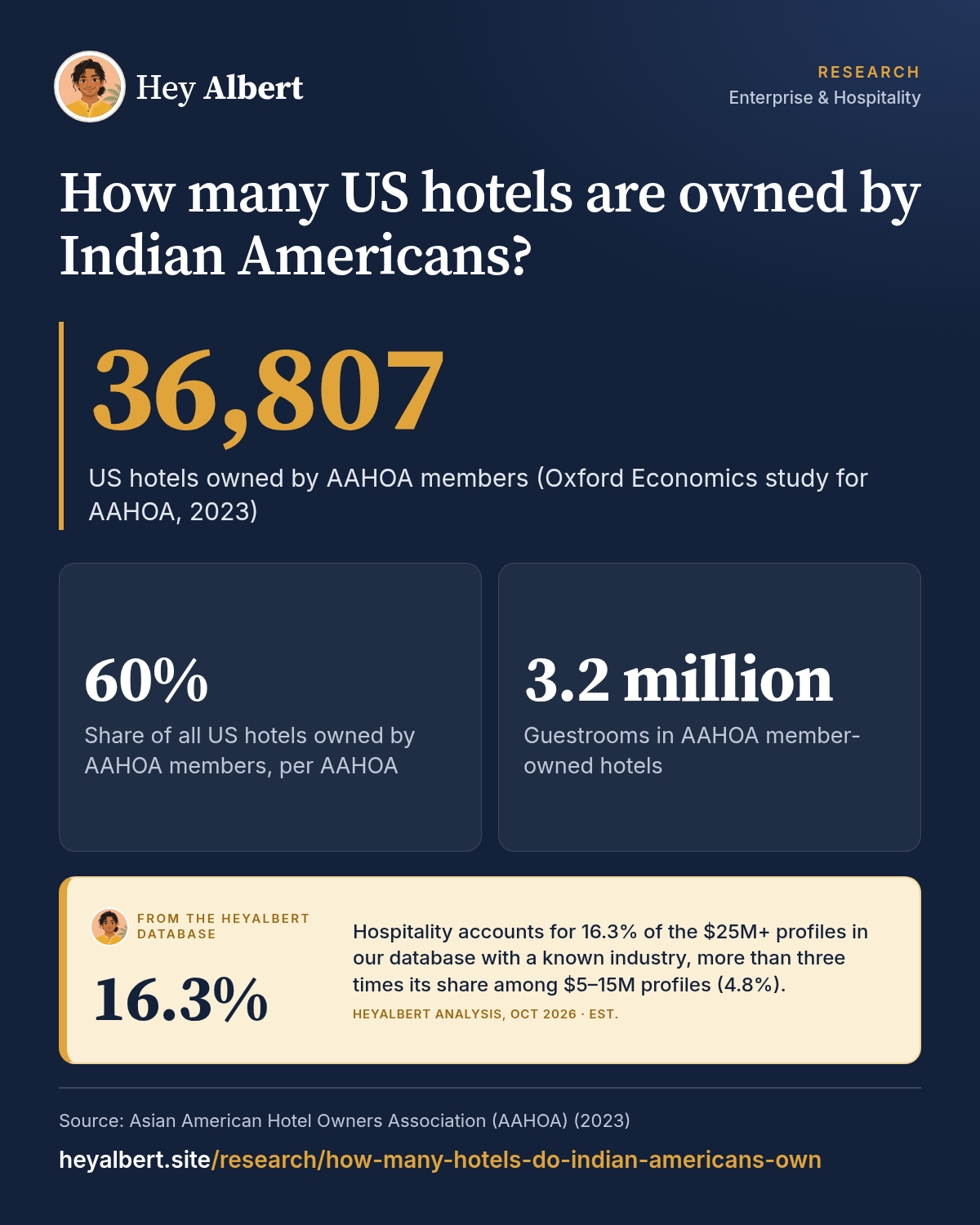
Members of the Asian American Hotel Owners Association (AAHOA), a trade group whose history is overwhelmingly Indian American, own 36,807 US hotels with 3.2 million guestrooms, about 60% of all US hotels, according to a study AAHOA commissioned from Oxford Economics1,2. No government source counts hotels by the owner's ethnicity, so this association figure is the standard reference.
HeyAlbert data shows hospitality accounts for 16.3% of the $25M+ profiles in our database with a known industry, more than three times its share among $5–15M profiles (4.8%). See the data · Methodology
The headline number and where it comes from
The most widely cited figure comes from AAHOA, the largest hotel owners' association in the country. AAHOA says its nearly 20,000 members own 36,807 hotels in the US, with 3.2 million guestrooms, and that these properties represent 60% of all US hotels1. The figures come from an economic-impact study AAHOA commissioned from Oxford Economics; the study's infographic, dated December 2023, describes a two-year research process with a deep-dive sample of 5,000 hotels and a margin of error of plus or minus 1.4%2. The full national report, which reflects 2022 data, puts the precise estimate at 59.5% of US hotel properties and 58% of rooms, and counts a hotel as AAHOA-owned if a member holds an ownership interest or, for corporate-owned hotels, a senior executive role8.
The number has grown over time. When AAHOA first announced an Oxford Economics study in August 2021, members owned 34,260 hotels with 3.1 million guestrooms, also put at 60% of the total4.
| Measure | 2021 study | Current study |
|---|---|---|
| AAHOA member-owned hotels | 34,260 | 36,807 |
| Guestrooms | 3.1 million | 3.2 million |
| Share of US hotels | 60% | 60% |
Sources: Hotel Online (2021)4; AAHOA (current)1.
What HeyAlbert data shows
Is AAHOA the same as Indian American ownership?
Not exactly, but close. AAHOA stands for the Asian American Hotel Owners Association, and membership is open beyond any single heritage. Its own account of its history, though, opens: "The story of AAHOA is the story of Indian Americans pursuing – and achieving – the American Dream"3. AAHOA was formed in 1989 after Indian American hoteliers who faced discrimination from banks and insurers organized to support one another3.
Independent research points the same way. Sociologist Pawan Dhingra, author of a book on Indian American motel owners, has estimated that at least one in two US motels is Indian American-owned, that about 70% of those owners are Gujarati and that about three-quarters of the Gujarati owners share the surname Patel5. NPR has noted that Indian immigrants and their children make up about 1% of the US population6. The history behind that concentration is told in how Gujarati Patel families came to own so many US motels.
What kinds of hotels are they?
The report shows the share is highest at the budget end: AAHOA members own an estimated 65.9% of economy-class hotels and 61.5% of upper-midscale hotels, but 40.8% of luxury hotels; economy properties make up 45.1% of members' hotels8. The portfolio leans toward smaller, limited-service and economy properties, though it has moved steadily upmarket. An independent review by Matthews Hotel Markets notes that 3.2 million rooms across 36,807 hotels works out to about 87 rooms per hotel, consistent with a membership weighted to select-service and economy properties7. Many are franchised: the American Hotel & Lodging Association says 57% of US hotels are franchised, meaning an independent owner licenses a brand name such as Hampton or Holiday Inn Express rather than the brand owning the building7.
That distinction matters for understanding the wealth involved. The large hotel companies own very few of the hotels that carry their names; the real estate, and the equity, sit with owners like AAHOA members. A Cornell hospitality professor told NPR that Gujarati owners played a huge role in the expansion of Best Western and Days Inn across the country, partly because they were willing to open in small towns6. Our analysis of Indian American franchise owners looks at the same model in convenience stores and restaurants.
How to read the 60% figure
Three cautions apply. First, it is a trade association's figure about its own members, produced by a firm it hired; no federal agency publishes hotel ownership by ethnicity7. Second, it is a share of hotel properties, not of rooms or revenue, and big full-service hotels and resorts owned by public REITs and institutional investors carry far more rooms and value per property7. Third, ownership is often partial, through partnerships and LLCs where one family holds stakes in several hotels.
Even with those caveats, hotels are one of the clearest examples of a community building wealth through real assets. The economic footprint, including jobs, taxes and contribution to GDP, is covered in the economic impact of Indian American-owned hotels.
From motels to diversified family enterprises
AAHOA notes that many of the original "accidental hoteliers" have passed their businesses to US-educated children, and that second- and third-generation owners and developers are building on that foundation3. Dhingra observes that children who return to the industry typically enter at a higher tier than their parents, moving from independent motels to branded and upscale hotels while keeping the family's networks and knowledge5.
Hotel cash flow has also funded moves into development and other property types, explored in Indian American real estate developers and the role of family businesses in Indian American wealth. Passing these assets between generations raises its own planning questions, covered in intergenerational wealth transfer. For how hospitality fits into the wider picture of business ownership, see how many businesses Indian Americans own.
Frequently asked questions
Do Indian Americans own 60% of US hotels?
AAHOA, the Asian American Hotel Owners Association, says its members own about 60% of US hotels, or 36,807 properties. Most AAHOA members are Indian American, but the figure covers all members and is the association's own estimate.
How many hotels do AAHOA members own?
According to AAHOA's Oxford Economics study, members own 36,807 US hotels with 3.2 million guestrooms. The previous study, announced in 2021, counted 34,260 hotels.
Why are so many US motels owned by people named Patel?
Many Indian American hotel owners trace their roots to Gujarat, and a large share of Gujarati owners share the surname Patel. Sociologist Pawan Dhingra estimates about three-quarters of Gujarati motel owners are Patels.
Is there an official government count of hotels by owner ethnicity?
No. Federal statistics do not report hotel ownership by ethnicity, so the AAHOA-commissioned study is the standard reference.
Sources
Figures are from the public sources below, with the data year stated. Estimates are labeled as estimates. Accessed October 24, 2026.
- Asian American Hotel Owners Association (AAHOA), Oxford Economics Study: AAHOA Ownership & Economic Impact (2023). aahoa.com ↩ ↩ ↩
- AAHOA / Oxford Economics, Oxford Economics Study infographic (dated 2023-12-20) (2023). aahoa.com ↩ ↩
- AAHOA, About AAHOA (mission and history) (2025). aahoa.com ↩ ↩ ↩
- Hotel Online, New AAHOA/Oxford Economics Study Details Extent of AAHOA Members' Economic Impact and Industry Influence (2021). hotel-online.com ↩ ↩ ↩
- NPR, 'Life Behind The Lobby' Of Indian-American Motels (interview with Pawan Dhingra) (2012). npr.org ↩ ↩
- NPR, Here To Stay: How Indian-Born Innkeepers Revolutionized America's Motels (2016). npr.org ↩ ↩
- Matthews Hotel Markets, Who owns hotels in the United States? (2026) (2026). matthewshotelmarkets.com ↩ ↩ ↩
- AAHOA / Oxford Economics, Oxford Economics Study: AAHOA Ownership & Economic Impact (national report, August 2023) (2023). aahoa.com ↩ ↩