
Short answer
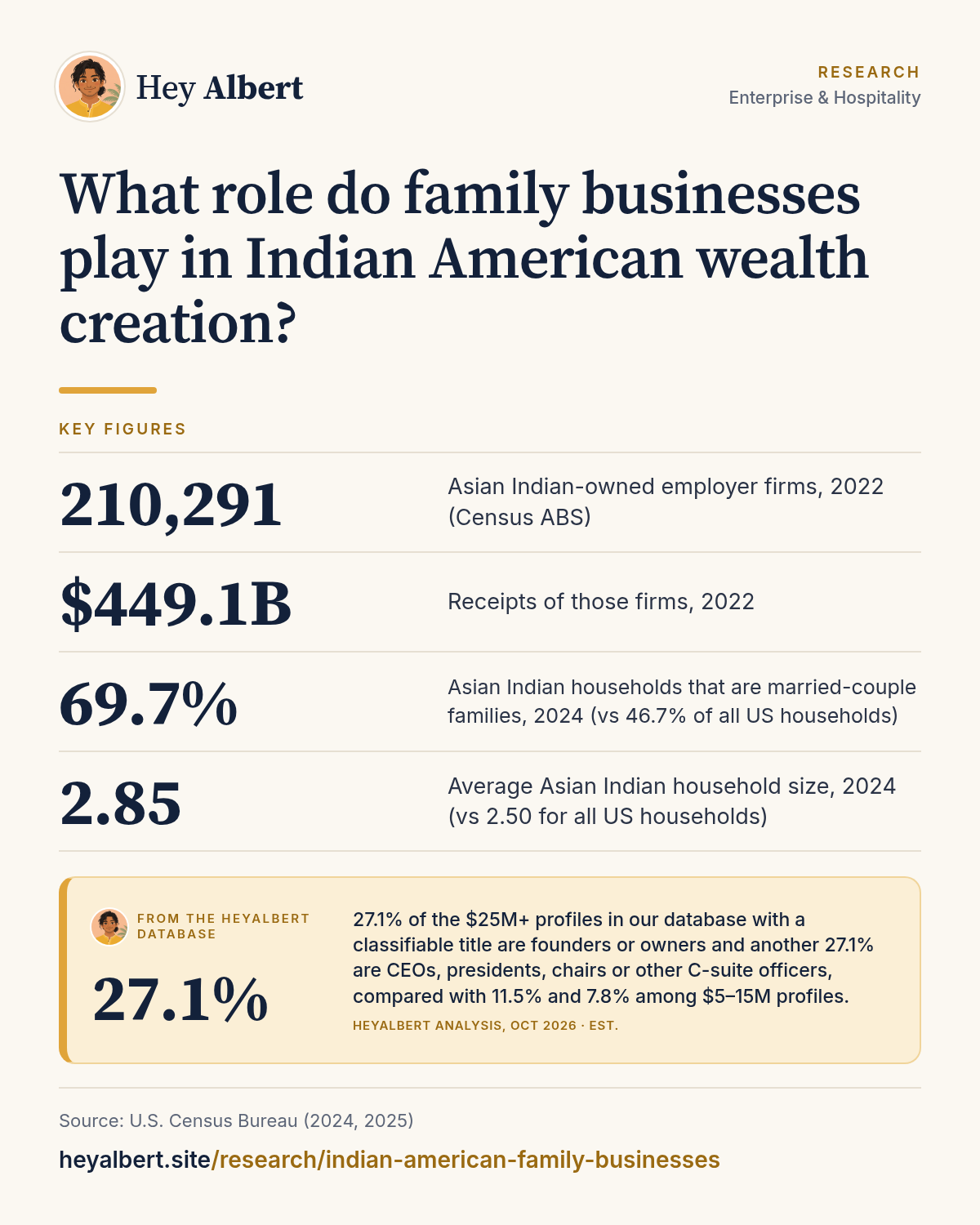
Family businesses are one of the two main engines of Indian American wealth, alongside high-paid professional careers. Asian Indian Americans owned 210,291 employer firms with $449.1 billion in receipts in 20221, many of them family-run hotels, stores and practices built with family labor and pooled capital and increasingly handed to a US-educated second generation2,3.
HeyAlbert data shows 27.1% of the $25M+ profiles in our database with a classifiable title are founders or owners and another 27.1% are CEOs, presidents, chairs or other C-suite officers, compared with 11.5% and 7.8% among $5–15M profiles. See the data · Methodology
Two routes to wealth
Indian American wealth has been built along two broad routes. One runs through education and professional careers in technology, medicine, finance and consulting, where income and stock compensation do the work. The other runs through family-owned businesses: hotels and motels, convenience stores and franchises, medical practices, IT firms and real estate. The second route is older, often less visible and particularly important for families who arrived without US credentials or through family-sponsored immigration.
The Census Bureau's Annual Business Survey gives a sense of the scale. In 2022 Asian Indian Americans owned 210,291 businesses with paid employees, with $449.1 billion in receipts and nearly 2 million employees1. The largest sectors were retail (57,877 firms), accommodation and food services (44,440), professional and technical services (35,945) and health care (29,371)1. The full breakdown is in how many businesses Indian Americans own.
What HeyAlbert data shows
How the family model works
The hotel industry offers the best-documented example. National Geographic, drawing on historian Mahendra Doshi, describes Gujarati families who bought motels, lived on the property and did every job themselves, from cleaning rooms to checking in guests, which kept costs low and sent profits toward the next acquisition5. Relatives extended each other "handshake loans" with no collateral and no repayment schedule5. AAHOA notes that early owners faced discrimination from banks and insurers, which made family and community capital essential2. The history is told in how Gujarati Patel families came to own so many US motels.
Household structure supports the model. In 2024, 69.7% of Asian Indian households were married-couple families, compared with 46.7% of all US households, and the average Asian Indian household had 2.85 people against 2.50 nationally4. Larger, more stable households can pool labor and savings, a theme explored in how multigenerational living affects wealth.
Many enterprises are run by couples. Syntel, the IT services firm sold to Atos for $3.4 billion in 2018, was founded by Bharat Desai and Neerja Sethi from their apartment in Troy, Michigan in 1980 with $2,000, according to Forbes6.
From one property to a portfolio
The family model scales through reinvestment. A first motel or store generates cash flow and a track record with lenders; the second and third follow. Some families went much further: NPR reported in 2016 that Hersha Hospitality Trust, which began with a 23-room motel in rural Pennsylvania where the founding family lived behind the lobby, had become a $2.5 billion company7. Today AAHOA says its members own about 60% of all US hotels2; see how many US hotels Indian Americans own. The same pattern appears in convenience stores and franchised restaurants, covered in Indian American franchise and convenience store owners.
Jobs and the local economy
Family enterprises matter well beyond the families that own them. Asian Indian-owned accommodation and food-service businesses alone employed 605,446 people in 2022, more than any other sector of Indian American ownership, and Asian Indian-owned retail firms employed another 274,4131. Health care practices, the third pillar, numbered 29,371 firms with 284,788 employees and $39.3 billion in receipts1. Many of these businesses sit in small towns and suburbs rather than the coastal technology hubs most associated with Indian American success, which is one reason the community's economic footprint is broader than its high-profile executives and founders suggest.
These businesses also anchor family wealth in tangible assets. Unlike a salary, a hotel, a store or a practice building can be refinanced, expanded, leased or passed down.
The second generation steps up, or steps away
AAHOA notes that many of the original "accidental hoteliers" have handed their businesses to US-educated children, now professional owners and developers2. Sociologist Pawan Dhingra observes that children who return to the family industry typically enter at a higher tier, such as branded or upscale hotels, while drawing on the same networks and knowledge3. Others choose professional careers and leave the business, which pushes families toward selling, hiring outside managers or converting operating businesses into passive real estate. Our piece on Indian American real estate developers follows families who made that move.
Succession, structure and cross-border questions
Family businesses concentrate wealth in a few illiquid assets, which makes succession planning central. Questions include who will run the business, how to treat children who do not join it, how to hold property across generations and how to manage assets or relatives in India. Those issues are covered in intergenerational wealth transfer among Indian Americans and how wealthy Indian Americans run family offices.
Frequently asked questions
How important are family businesses to Indian American wealth?
Very. Asian Indian Americans owned 210,291 employer businesses with $449.1 billion in receipts in 2022, many of them family-run hotels, stores, practices and IT firms.
Why do Indian American families often run businesses together?
Family labor keeps costs low, pooled savings and informal loans provide capital, and larger, more stable households make it easier to share the work. Early owners also faced discrimination from banks and insurers, which made family capital essential.
Do second-generation Indian Americans take over family businesses?
Many do, often moving the business upmarket, for example from independent motels to branded hotels. Others pursue professional careers, leading families to sell or convert businesses into passive real estate.
What industries are Indian American family businesses in?
The largest sectors are retail, accommodation and food services, professional and technical services, and health care, according to the Census Bureau.
Sources
Figures are from the public sources below, with the data year stated. Estimates are labeled as estimates. Accessed October 24, 2026.
- US Census Bureau, Annual Business Survey: Statistics for Employer Firms by Industry, Sex, Ethnicity, Race, and Veteran Status for the U.S.: 2022 (AB2200CSA01) (2024). data.census.gov ↩ ↩ ↩
- AAHOA, About AAHOA (mission and history) (2025). aahoa.com ↩ ↩ ↩
- NPR, 'Life Behind The Lobby' Of Indian-American Motels (interview with Pawan Dhingra) (2012). npr.org ↩ ↩
- US Census Bureau, American Community Survey 2024 1-year, Selected Population Profile (S0201), Asian Indian alone (2025). data.census.gov ↩ ↩ ↩
- National Geographic, How Indian Americans Came to Run Half of All U.S. Motels (2018). nationalgeographic.com ↩ ↩
- Forbes, Bharat Desai (profile) (2026). forbes.com ↩
- NPR, Here To Stay: How Indian-Born Innkeepers Revolutionized America's Motels (2016). npr.org ↩