
Short answer
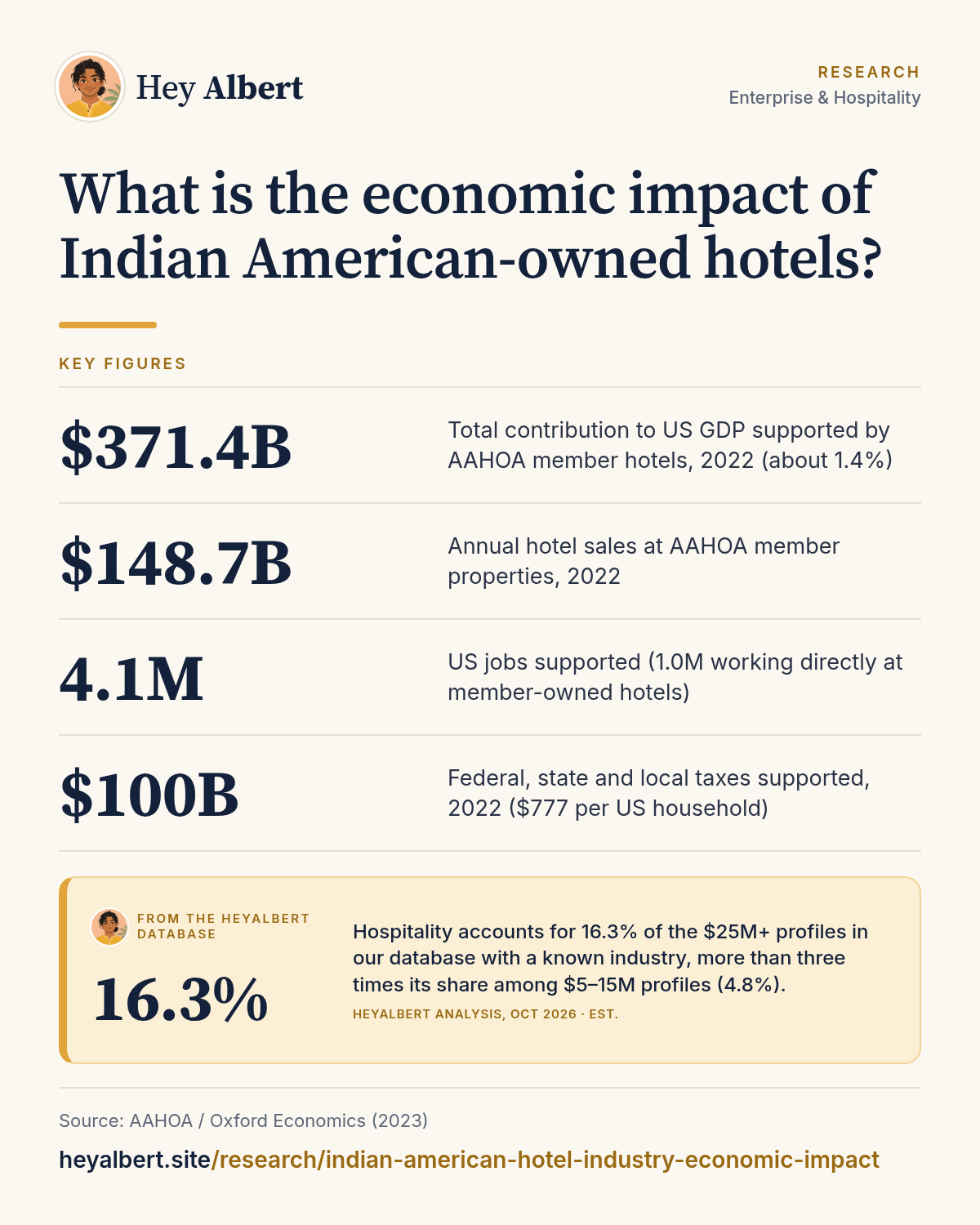
Hotels owned by members of AAHOA, the predominantly Indian American hotel owners' association, generated $148.7 billion in hotel sales in 2022 and, counting guest spending, construction and supply chains, supported $371.4 billion of US GDP (about 1.4%), 4.1 million jobs and $100 billion in federal, state and local taxes, according to an Oxford Economics study commissioned by AAHOA1,2.
HeyAlbert data shows hospitality accounts for 16.3% of the $25M+ profiles in our database with a known industry, more than three times its share among $5–15M profiles (4.8%). See the data · Methodology
The headline impact
The most complete measure of the hotel economy built by Indian American owners is an economic-impact study that AAHOA, the Asian American Hotel Owners Association, commissioned from Oxford Economics. Published in August 2023 and reflecting 2022 data, it covers the 36,807 hotels (annual average) in which an AAHOA member holds an ownership interest or, for corporate-owned hotels, a senior executive role1. AAHOA's own history describes the association as "the story of Indian Americans"3; our explainer on how many US hotels Indian Americans own covers what that 60% ownership figure does and does not mean.
| Impact, 2022 | Direct (hotel operations) | Total (incl. guest spending, capital investment, indirect and induced) |
|---|---|---|
| Sales / output | $148.7B | $704.8B |
| GDP | $94.2B | $371.4B |
| Jobs | 1.0 million | 4.1 million |
| Wages and compensation | $51.3B | $225.9B |
| Taxes | $32.6B | $100.0B |
Source: Oxford Economics for AAHOA1.
What HeyAlbert data shows
Jobs, wages and taxes
About 1 million people work directly at AAHOA member-owned hotels, earning $51.3 billion a year1. Adding guest spending at nearby businesses, hotel construction and renovation, and the spending of suppliers and employees, the study estimates 4.1 million jobs and $225.9 billion in wages and other compensation1.
The tax footprint is large: $100 billion in 2022, split between $50.8 billion in federal taxes and $49.2 billion in state and local taxes, including $12.9 billion in lodging taxes and $14.4 billion in property taxes1. Oxford expresses the total as $777 per US household per year, or $30,867 per AAHOA guestroom1. A representative member hotel with 100 occupied rooms supports 205 jobs and $2.4 million a year in state and local tax revenue, according to the report1.
Guest spending and supply chains
Guests at AAHOA hotels spent $327.9 billion in 2022 on rooms and at local restaurants, shops and transportation, and the hotels themselves bought $51.3 billion of goods and services from other businesses1. This ripple effect is why small-town hotels matter to local economies: a Cornell hospitality professor told NPR that Gujarati owners helped put a hotel in nearly every small community in America by opening where other investors would not4. The history of that expansion is told in how Gujarati Patel families came to own so many motels.
Building and renovating: capital investment
Owners do not just operate hotels; they build and refresh them. AAHOA member hotels generated $17.7 billion in direct capital investment in 2022, through new construction and renovation of existing properties, supporting 116,200 direct jobs in construction and design1. Counting suppliers and the spending of those workers, capital investment supported $46.9 billion in business sales and about 246,000 jobs in total1. That pipeline of new projects is one reason second-generation owners increasingly describe themselves as developers rather than operators.
The mix of properties shapes the impact. Oxford estimates members own 65.9% of US economy-class hotels and 61.5% of upper-midscale hotels, falling to 47.5% of upper-upscale and 40.8% of luxury hotels; economy properties account for 45.1% of the member portfolio1. Smaller, limited-service hotels employ fewer staff per property than full-service resorts, so the job counts reflect sheer number of properties as much as size.
Where the impact is concentrated
Ownership is national but uneven. Oxford estimates AAHOA members own 88.9% of hotels in Texas, 89.4% in Oklahoma and Arkansas, and 88.8% in Louisiana, compared with about a third in New England1. By count, Texas leads with 5,261 member hotels, 14.4% of the total, followed by California (3,964) and Florida (2,865)1.
| State | AAHOA member hotels | Member share of state's hotels |
|---|---|---|
| Texas | 5,261 | 88.9% |
| California | 3,964 | 61.0% |
| Florida | 2,865 | 64.8% |
| Georgia | 1,501 | 67.7% |
| North Carolina | 1,316 | 67.5% |
Source: Oxford Economics for AAHOA1. The Texas story overlaps with the state's fast-growing Indian American population, discussed in Indian Americans in Dallas, Houston and Austin.
From economic footprint to family wealth
Impact figures measure economic activity, not owners' net worth. Hotel sales of $148.7 billion are revenue, before operating costs, debt service and franchise fees1. Still, hotels are real assets that appreciate, can be refinanced and can be passed down, which is why hospitality is a foundation of many Indian American family balance sheets. Owners often reinvest into development and other property, covered in Indian American real estate developers, and larger families increasingly formalize holdings through family offices. For hospitality's place in the community's overall contribution, see how much Indian Americans contribute to the US economy and Indian American business ownership.
Caveats
The study was commissioned by AAHOA about its own members, and ownership was identified by AAHOA researching a random sample of 5,000 hotels supplied by Lodging Econometrics, with a stated national margin of error of plus or minus 1.4% (wider for states and classes)1. Total-impact figures rely on standard economic multipliers, which estimate supported activity rather than activity caused solely by these owners. No government source measures hotel ownership by ethnicity.
Frequently asked questions
How much do Indian American-owned hotels contribute to the US economy?
Hotels owned by AAHOA members, most of whom are Indian American, supported $371.4 billion of US GDP in 2022, about 1.4% of the total, according to an Oxford Economics study commissioned by AAHOA.
How many jobs do AAHOA hotels support?
About 1 million people work directly at AAHOA member-owned hotels, and the study estimates 4.1 million jobs supported in total once guest spending and supply chains are included.
Which state has the most Indian American-owned hotels?
Texas, with 5,261 AAHOA member hotels in 2022, about 14.4% of the total. Members own an estimated 88.9% of the state's hotels.
How much tax do these hotels generate?
About $100 billion in federal, state and local taxes in 2022, including $12.9 billion in lodging taxes, or roughly $777 per US household.
Sources
Figures are from the public sources below, with the data year stated. Estimates are labeled as estimates. Accessed October 24, 2026.
- AAHOA / Oxford Economics, Oxford Economics Study: AAHOA Ownership & Economic Impact (national report, August 2023, 2022 data) (2023). aahoa.com ↩ ↩ ↩
- AAHOA, Oxford Economics Study: AAHOA Ownership & Economic Impact (summary page) (2023). aahoa.com ↩
- AAHOA, About AAHOA (mission and history) (2025). aahoa.com ↩
- NPR, Here To Stay: How Indian-Born Innkeepers Revolutionized America's Motels (2016). npr.org ↩