
Short answer
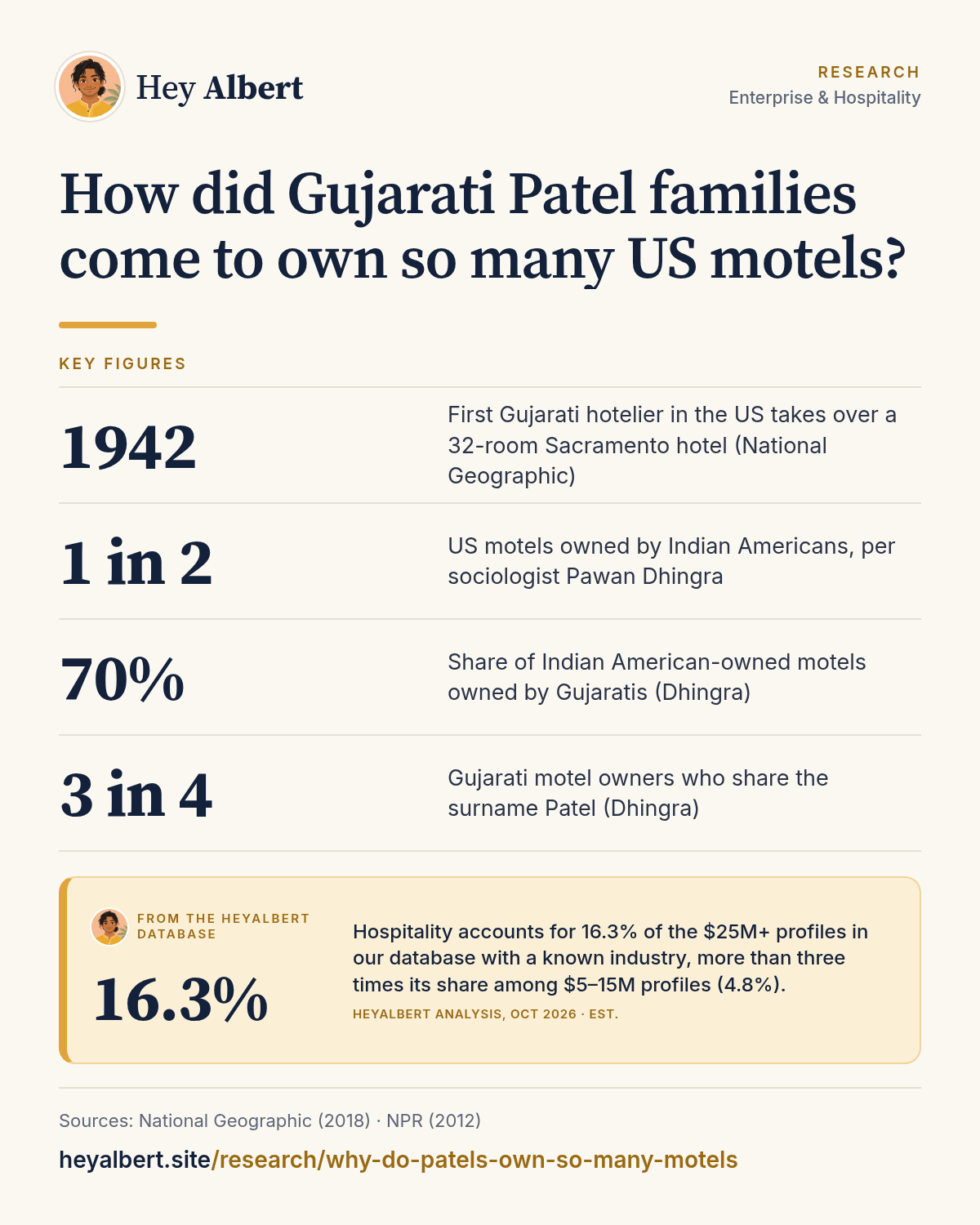
Gujarati immigrants entered the US hotel business in the 1940s, when Kanji Manchhu Desai took over a Sacramento hotel and encouraged fellow Gujaratis to follow, and the trend accelerated after the 1965 immigration reform1,3. Families lived in their motels, pooled savings through informal "handshake loans" and bought cheap properties, and today sociologist Pawan Dhingra estimates at least half of US motels are Indian American-owned, about 70% of those by Gujaratis and three-quarters of those by Patels1,2.
HeyAlbert data shows hospitality accounts for 16.3% of the $25M+ profiles in our database with a known industry, more than three times its share among $5–15M profiles (4.8%). See the data · Methodology
An accident of history in the 1940s
The story begins during World War II. According to National Geographic, the first Gujarati hotelier in the US was Kanji Manchhu Desai, who in 1942 joined two Gujarati farmworkers to take over a 32-room hotel in Sacramento after its Japanese American owner was forced into an internment camp1. In 1947 Desai moved to the Hotel Goldfield in San Francisco, which became a landing place for new arrivals from Gujarat, and he urged them into the business: "If you are a Patel, lease a hotel"1. (NPR's account places Desai's first purchase in San Francisco in the early 1940s; the details vary by source3.)
Sociologist Pawan Dhingra, who wrote the leading academic study of Indian American motel owners, describes it as falling into the industry "by accident." Residential hotels of the 1940s and 1950s were seen as rough and unprofitable; Japanese American owners had been interned and European American owners and their children wanted out, so the properties were cheap2.
What HeyAlbert data shows
Why motels fit Gujarati immigrants
Several features made motels an unusually good match:
- A business that came with a home. Families lived on site, often in an apartment behind the lobby, so the motel solved housing and work at once2.
- Family labor. Relatives did everything from cleaning rooms to the front desk, keeping costs low and sending profits toward the next property1.
- Pooled capital. Owners extended each other "handshake loans" with no collateral and no payment schedule, according to historian Mahendra Doshi, quoted by National Geographic1.
- An entrepreneurial tradition. Dhingra notes Gujaratis have a long tradition of working for themselves rather than for someone else3.
Hotel historian Stanley Turkel adds two more: a distressed roadside motel could be bought for around $40,000, which in the mid-1970s was the amount an immigrant investor needed to apply for permanent residence, and the 1973 oil embargo and gasoline shortage had depressed motel prices just as these buyers arrived4. These were trade-history accounts rather than official statistics, but they help explain the timing. The role of family enterprise more broadly is covered in what role family businesses play in Indian American wealth.
1965, East Africa and the surge of the 1970s
Gujaratis began buying motels in earnest after 1965, the year US immigration law began admitting more people from developing countries, NPR reports3. A second wave came from East Africa, where many Gujarati families had lived for generations: in 1972 Uganda's ruler Idi Amin expelled tens of thousands of Asians, most of whom went to Britain, and Gujaratis from across East and Southern Africa later moved on to North America4. Many arrived with commercial experience. The broader immigration story is told in foreign-born vs US-born Indian Americans.
Discrimination shaped the model. AAHOA says early Indian American hoteliers faced discrimination from banks and insurance companies, and they organized into groups that eventually became the Asian American Hotel Owners Association in 19895. Turkel writes that because conventional insurers and lenders turned them away, owners financed each other and self-insured4.
Why "Patel"?
Patel is a common surname in Gujarat, historically associated with landholding farming communities4. Because early hoteliers recruited relatives and fellow villagers, the surname spread through the industry with the business itself. Dhingra estimates that at least one in two US motels is Indian American-owned, that roughly 70% of those owners are Gujarati, and that about three-quarters of the Gujarati owners are Patels2. The nickname "Patel motel" grew out of that concentration2.
From motels to a hospitality powerhouse
Franchising let the model scale. A Cornell hospitality professor told NPR that Gujarati owners played a huge role in the expansion of Best Western and Days Inn, partly because they were willing to open in small towns that bigger investors ignored3. Some families built public companies: NPR reported in 2016 that Hersha Hospitality Trust, founded by Hasu P. Shah, who started with a 23-room motel in rural Pennsylvania, had become a $2.5 billion company3.
Today AAHOA says its members own about 60% of all US hotels5; our breakdown of how many US hotels Indian Americans own explains that figure and its limits, and the economic impact of Indian American-owned hotels covers jobs, taxes and GDP.
The next generation
AAHOA notes that many of the original "accidental hoteliers" have handed the business to US-educated children who are now professional owners and developers5. Dhingra observes that children who return to the industry usually enter at a higher tier, such as branded or upscale hotels, while drawing on the same family networks2. Many have diversified into development and other real estate, as described in Indian American real estate developers, and into franchised retail, covered in franchise and convenience store owners. For how family hotel portfolios are passed on, see intergenerational wealth transfer among Indian Americans.
Frequently asked questions
Who was the first Indian American hotel owner?
National Geographic identifies Kanji Manchhu Desai, who in 1942 helped take over a 32-room hotel in Sacramento after its Japanese American owner was interned. He later ran the Hotel Goldfield in San Francisco and encouraged other Gujaratis to enter the business.
Why are so many motel owners named Patel?
Many early hoteliers came from Gujarat, where Patel is a common surname, and they recruited relatives and neighbors. Sociologist Pawan Dhingra estimates about three-quarters of Gujarati motel owners are Patels.
How did Gujarati families afford motels?
They bought inexpensive, often distressed properties, lived on site, used family labor and lent to each other through informal handshake loans, then reinvested profits into more properties.
What is AAHOA?
The Asian American Hotel Owners Association, founded in 1989 by hoteliers who faced discrimination from banks and insurers. It says its members now own about 60% of US hotels.
Sources
Figures are from the public sources below, with the data year stated. Estimates are labeled as estimates. Accessed October 24, 2026.
- National Geographic, How Indian Americans Came to Run Half of All U.S. Motels (2018). nationalgeographic.com ↩ ↩ ↩
- NPR, 'Life Behind The Lobby' Of Indian-American Motels (interview with Pawan Dhingra) (2012). npr.org ↩ ↩ ↩
- NPR, Here To Stay: How Indian-Born Innkeepers Revolutionized America's Motels (2016). npr.org ↩ ↩ ↩
- International Society of Hospitality Consultants, From Ragas To Riches, Part I (Stanley Turkel) (n.d.). ishc.com ↩ ↩ ↩
- AAHOA, About AAHOA (mission and history) (2025). aahoa.com ↩ ↩ ↩