
Short answer
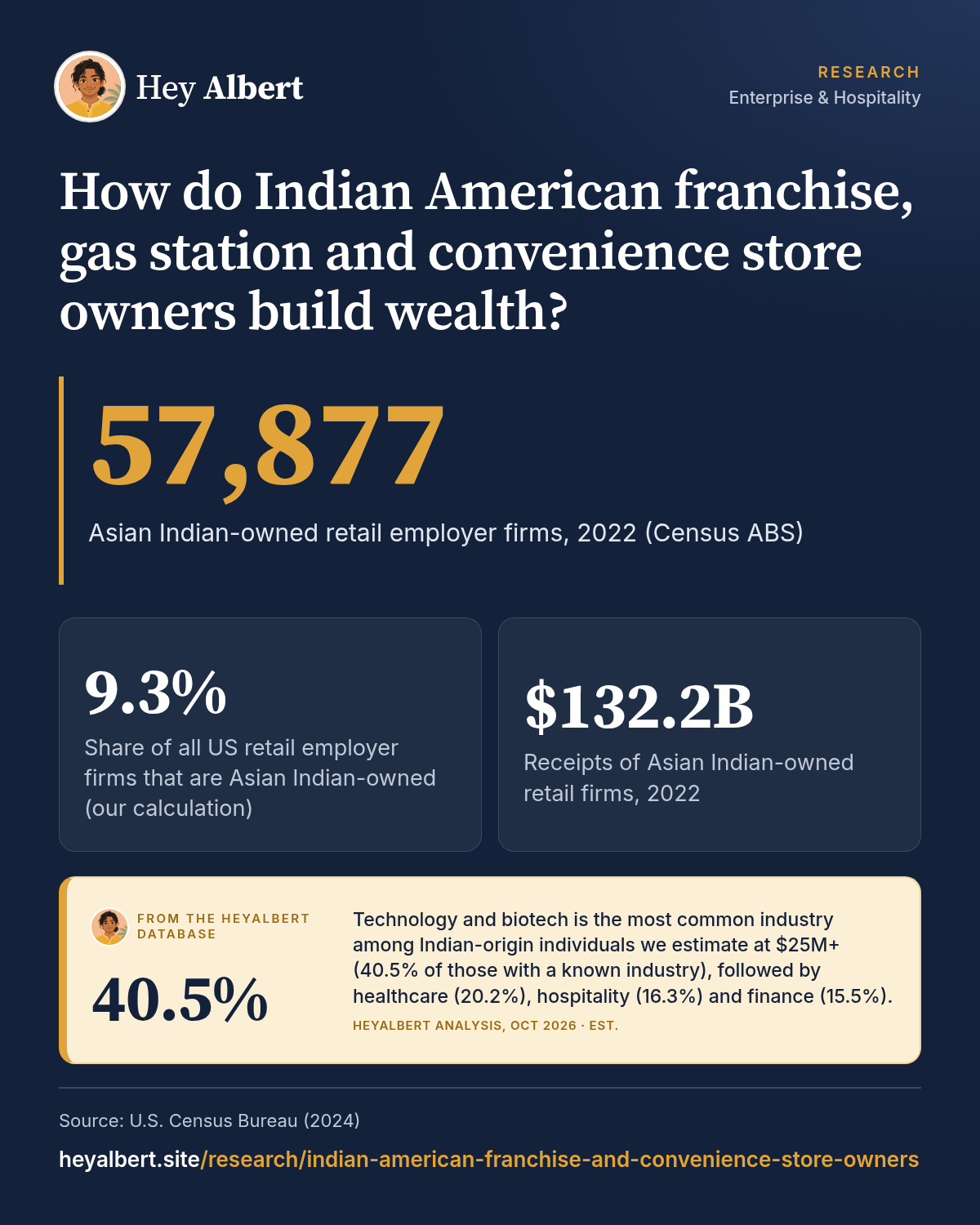
Retail is the largest sector for Indian American business owners: Asian Indian Americans owned 57,877 retail employer firms in 2022, about 9.3% of all US retail employer firms, with $132.2 billion in receipts, plus 44,440 accommodation and food-service firms, according to the Census Bureau1. Owners typically build wealth by buying franchised or fuel-branded stores, running them with family labor, and reinvesting cash flow into more units and the underlying real estate.
HeyAlbert data shows technology and biotech is the most common industry among Indian-origin individuals we estimate at $25M+ (40.5% of those with a known industry), followed by healthcare (20.2%), hospitality (16.3%) and finance (15.5%). See the data · Methodology
What the official data show
No government survey reports franchise ownership or gas-station ownership by ethnicity, so claims you may see online, such as Indian Americans owning half of all gas stations, cannot be verified. The Census Bureau's Annual Business Survey does, however, report employer firms by owner race and industry, and it shows how central retail and food service are1.
| Sector (2022) | Asian Indian-owned firms | Receipts | Employees |
|---|---|---|---|
| Retail trade | 57,877 | $132.2B | 274,413 |
| Accommodation and food services | 44,440 | $57.4B | 605,446 |
Source: US Census Bureau, Annual Business Survey 20221.
Retail is the single largest category of Asian Indian-owned employer firms, and on our calculation from the same table roughly one in eleven US retail employer firms is Asian Indian-owned, against about 1.5% of the population1,3. Retail in the ABS includes gas stations with convenience stores, grocery and liquor stores, pharmacies and other shops. The full industry breakdown is in how many businesses Indian Americans own.
What HeyAlbert data shows
Why convenience stores and gas stations?
The convenience store industry is built for owner-operators. The National Association of Convenience Stores (NACS) counts nearly 152,000 US convenience stores, more than 120,000 of which sell fuel, and says about 55% of fuel-selling stores are single-store operators2. Many of those owners sell a major oil brand on the canopy without being owned by the oil company, NACS notes, which leads customers to assume the store is corporate2. NACS also notes that convenience stores sell an estimated 80% of the fuel bought in the US, and that the shift happened after the price shocks of the 1970s pushed drivers toward self-service fueling2.
For immigrant families that model has clear advantages: a known brand and fuel supply contract, long opening hours that family members can share, steady cash flow from fuel and in-store sales, and a property that can later be refinanced or sold. It mirrors the motel model described in how Gujarati Patel families came to own so many motels, where living close to the business and relying on family labor kept costs low and funded the next purchase.
Franchising: hotels, coffee and quick service
Franchising is the bridge between small-business ownership and multi-unit enterprise. In hotels, independent owners license brands rather than the brands owning the buildings; the American Hotel & Lodging Association says 57% of US hotels are franchised4. A Cornell hospitality professor told NPR that Gujarati owners played a huge role in the expansion of Best Western and Days Inn, partly by opening in small towns5. Hotel consultant Stanley Turkel has written that, by some reports, at least half of new hotel franchisees since 1992 were Indian-owned; that is an industry estimate, not an official statistic6.
Food franchising followed a similar path. The Juggernaut, reporting on Dunkin', describes Indian, Pakistani and Bangladeshi immigrants as a big part of the chain's success, while noting that as larger franchise networks take over, newer arrivals can no longer easily get a foot in the door7. Our article on how many US hotels Indian Americans own covers the largest franchised segment.
How the wealth is built
- Start with one unit. Families often buy an existing store or franchise, sometimes with pooled savings from relatives, and work it themselves.
- Scale to multi-unit. Cash flow and lender relationships fund a second and third location; multi-unit operators become regional employers.
- Own the dirt. Buying the land and building, rather than leasing, turns operating income into appreciating real estate, a route explored in Indian American real estate developers.
- Diversify. Proceeds move into hotels, commercial property and liquid investments; see how Indian Americans invest their wealth.
On the ABS figures, Asian Indian-owned retail firms averaged about $2.3 million in receipts and accommodation and food-service firms about $1.3 million (our calculations)1. Receipts are revenue, not profit: fuel margins are thin, and much of the value lies in in-store sales and the property.
Family, succession and risk
These are mostly family businesses, and their long-term value depends on succession. Children educated in professions may not want to run a store, so families increasingly sell, consolidate under larger operators or convert holdings into passive real estate. Our pieces on family businesses in Indian American wealth creation and intergenerational wealth transfer discuss those choices.
The risks are real: long hours, robbery exposure, thin fuel margins, the shift to electric vehicles and consolidation by large chains. NACS notes that between 2% and 3% of vehicles on the road are electric today2, a small but growing change for fuel-dependent stores.
Frequently asked questions
Do Indian Americans own most gas stations in the US?
There is no official data on gas-station ownership by ethnicity, so claims like 'half of all gas stations' cannot be verified. Census data show Asian Indian Americans owned 57,877 retail employer firms in 2022, about one in eleven US retail employer firms.
Why do many Indian American families own convenience stores?
The model suits family businesses: a recognizable brand, steady cash flow, long hours shared among relatives and property that can be refinanced. Over half of fuel-selling convenience stores are run by single-store operators, according to NACS.
Are many franchise owners Indian American?
Indian Americans are prominent in hotel and quick-service franchising, but no official statistic counts franchisees by ethnicity. Hotels are the best documented: AAHOA members own about 60% of US hotels, many of them franchised.
How much revenue do Indian American-owned stores make?
Asian Indian-owned retail employer firms reported $132.2 billion in receipts in 2022, an average of about $2.3 million per firm, according to Census Bureau data.
Sources
Figures are from the public sources below, with the data year stated. Estimates are labeled as estimates. Accessed October 24, 2026.
- US Census Bureau, Annual Business Survey: Statistics for Employer Firms by Industry, Sex, Ethnicity, Race, and Veteran Status for the U.S.: 2022 (AB2200CSA01) (2024). data.census.gov ↩ ↩ ↩
- NACS (National Association of Convenience Stores), Convenience Stores Sell the Most Gas (2026). convenience.org ↩ ↩ ↩
- US Census Bureau, American Community Survey 2024 1-year, Selected Population Profile (S0201), Asian Indian alone (2025). data.census.gov ↩
- Matthews Hotel Markets, Who owns hotels in the United States? (2026) (2026). matthewshotelmarkets.com ↩
- NPR, Here To Stay: How Indian-Born Innkeepers Revolutionized America's Motels (2016). npr.org ↩
- International Society of Hospitality Consultants, From Ragas To Riches, Part I (Stanley Turkel) (n.d.). ishc.com ↩
- The Juggernaut, Dunkin' Runs on South Asian America (2021). thejuggernaut.com ↩