
Short answer
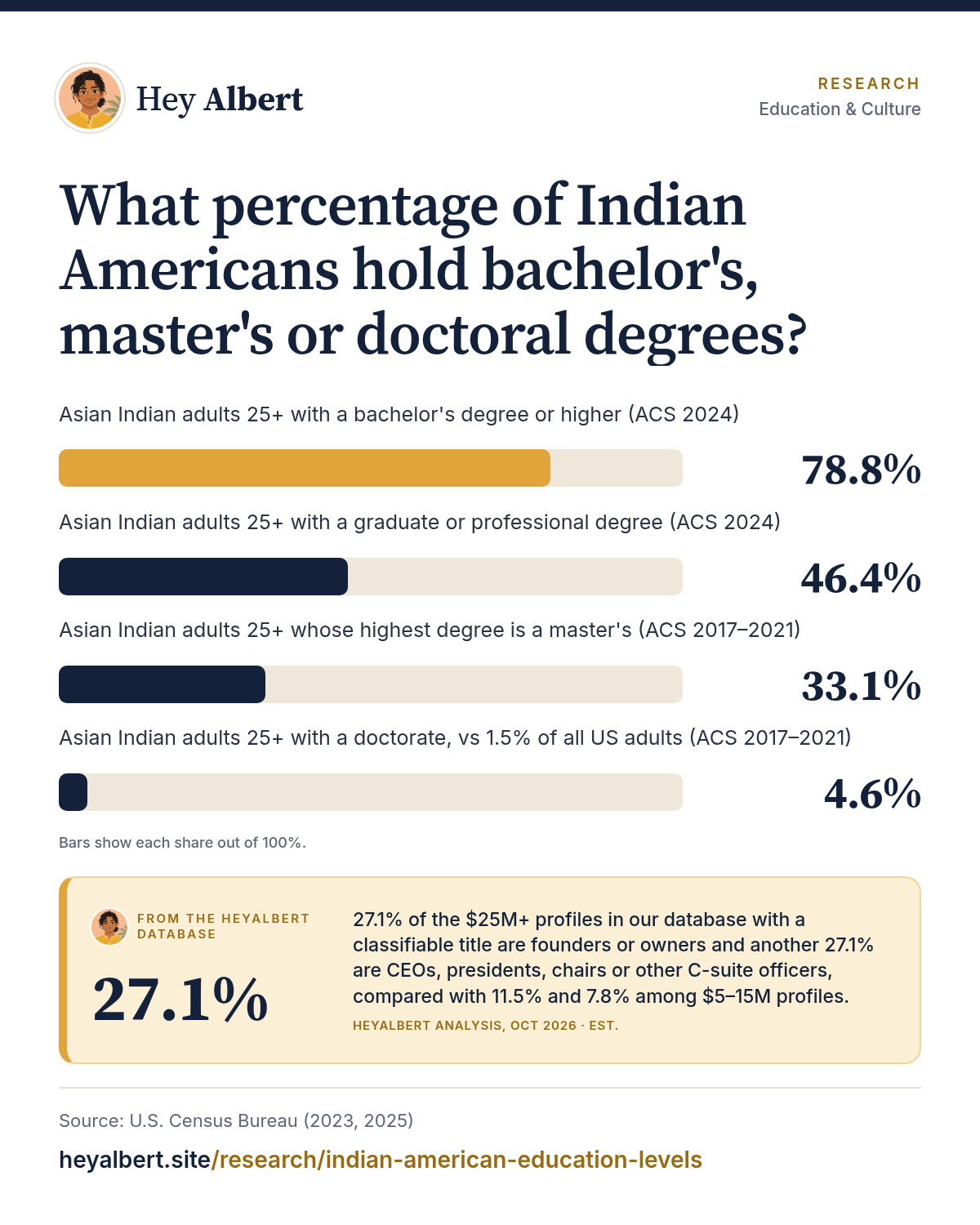
In 2024, 78.8% of Asian Indian adults aged 25 and older held at least a bachelor's degree and 46.4% held a graduate or professional degree, compared with 36.8% and 14.7% of all US adults1,2. Broken down further (2017–2021 data), about 33% held a master's degree, 6.6% a professional degree such as an MD or JD, and 4.6% a doctorate3.
HeyAlbert data shows 27.1% of the $25M+ profiles in our database with a classifiable title are founders or owners and another 27.1% are CEOs, presidents, chairs or other C-suite officers, compared with 11.5% and 7.8% among $5–15M profiles. See the data · Methodology
The headline numbers
Indian Americans are the most highly educated large population group in the United States. In the Census Bureau's 2024 American Community Survey, the latest available, 78.8% of Asian Indian adults aged 25 and over had at least a bachelor's degree, and 46.4% had a graduate or professional degree1. For all US adults the figures were 36.8% and 14.7%2. In other words, an Asian Indian adult is about three times as likely as the average American adult to hold a graduate degree.
Other sources line up. Pew Research Center, using 2021–23 data for people who identify as Indian alone or in combination, found 77% with a bachelor's degree or more, including 45% with an advanced degree4. Among Indian immigrants specifically, the Migration Policy Institute reports 82% with at least a bachelor's degree and 50% with an advanced degree in 20245.
What HeyAlbert data shows
Master's, professional and doctoral degrees
The one-year survey groups all graduate degrees together. The Census Bureau's 2017–2021 five-year detailed tables split them out. Highest degree held, adults 25 and over3:
| Highest degree | Asian Indian alone | Asian alone | White, not Hispanic | All US adults |
|---|---|---|---|---|
| Bachelor's | 32.0% | 30.6% | 22.9% | 20.6% |
| Master's | 33.1% | 16.8% | 10.3% | 9.3% |
| Professional (MD, JD, etc.) | 6.6% | 4.2% | 2.5% | 2.2% |
| Doctorate (PhD, etc.) | 4.6% | 4.1% | 1.6% | 1.5% |
The standout is the master's degree. One in three Asian Indian adults holds a master's as their highest degree, roughly three and a half times the national rate. Professional degrees reflect the community's large presence in medicine, covered in how many US doctors are Indian American.
How Indian Americans compare with other groups
Educational attainment, adults 25 and over, ACS 2024 one-year estimates1,2,6:
| Group | Bachelor's or higher | Graduate or professional degree |
|---|---|---|
| Taiwanese alone | 81.5% | 50.7% |
| Asian Indian alone | 78.8% | 46.4% |
| Korean alone | 63.4% | 26.5% |
| Pakistani alone | 61.8% | 29.4% |
| Chinese alone | 61.3% | 33.3% |
| Asian alone (all origins) | 59.1% | 27.4% |
| White alone, not Hispanic | 40.8% | 16.2% |
| All US adults | 36.8% | 14.7% |
Taiwanese Americans, a much smaller population of about 300,000, edge out Asian Indians on both measures6. Among groups of more than a million people, Asian Indians have the highest attainment by a wide margin. Because Asian Indian adults number about 3.6 million aged 25 and over1, they also account for a very large absolute number of graduate-degree holders: on the 2024 figures, roughly 1.65 million people, an estimate derived from the Census percentages.
There is a gender gap, though both men and women are far above national norms. In the 2017–2021 data, 78.9% of Asian Indian men aged 25 and over held at least a bachelor's degree and 47.9% a graduate or professional degree, compared with 73.4% and 40.3% of Asian Indian women3.
Why education levels are so high
The main driver is immigration policy. About 69% of Asian Indians in the US were born abroad1, and the visa routes most used by Indians reward advanced education. Indian nationals received 71% of all H-1B skilled-worker visas in fiscal 2024, and India was the leading source of international students in the US in the 2024–25 academic year, most of them in STEM programs5. A student visa followed by a work visa and then a green card is a common path, and each step selects for higher education. We cover this in the role of the H-1B visa in Indian American wealth and why Indian Americans choose STEM and medicine.
The pattern is not only an immigrant one. Pew found that US-born Indian Americans aged 25 and over were about as likely as immigrants to hold a bachelor's degree or more (76% versus 77%)4.
How education connects to income
Degrees translate into occupations. In 2024, 75.7% of employed Asian Indians worked in management, business, science and arts occupations, compared with 43.5% of all US workers1,2. That occupational mix is the main reason the median Asian Indian household earned $165,721 in 2024, about twice the national median1,2. See why Indian Americans are wealthier than average and Indian American median household income.
For how education and earnings carry across generations, see whether second-generation Indian Americans out-earn their parents.
Caveats
These are averages over a population of more than five million people. Educational attainment varies by year of arrival, visa type and region, and a meaningful share of Indian immigrants came through family-based routes rather than skilled-worker visas: in fiscal 2023, 60% of Indians who received green cards did so as relatives of US citizens or permanent residents5. The five-year detailed figures (2017–2021) are also older than the 2024 headline numbers and may understate today's graduate-degree share.
Frequently asked questions
What percentage of Indian Americans have a college degree?
In 2024, 78.8% of Asian Indian adults aged 25 and over held at least a bachelor's degree, compared with 36.8% of all US adults.
What percentage of Indian Americans have a master's degree?
In the Census Bureau's 2017 to 2021 data, 33.1% of Asian Indian adults held a master's degree as their highest degree, about three and a half times the national rate of 9.3%.
How many Indian Americans have a PhD or doctorate?
About 4.6% of Asian Indian adults held a doctorate in the 2017 to 2021 data, compared with 1.5% of all US adults. Another 6.6% held a professional degree such as an MD or JD.
Are US-born Indian Americans as educated as immigrants?
Yes. Pew found that 76% of US-born Indian Americans aged 25 and older held a bachelor's degree or more, almost the same as the 77% of immigrants.
Sources
Figures are from the public sources below, with the data year stated. Estimates are labeled as estimates. Accessed October 24, 2026.
- U.S. Census Bureau, Selected Population Profile in the United States (S0201): Asian Indian alone, 2024 ACS 1-year estimates (2025). data.census.gov ↩ ↩ ↩
- U.S. Census Bureau, Selected Population Profile in the United States (S0201): Total population, 2024 ACS 1-year estimates (2025). data.census.gov ↩ ↩ ↩
- U.S. Census Bureau, Sex by Educational Attainment for the Population 25 Years and Over (B15002), 2017–2021 ACS 5-year Selected Population Detailed Tables (2023). data.census.gov ↩ ↩ ↩
- Pew Research Center, Facts about Indians in the U.S. (2025). pewresearch.org ↩ ↩
- Migration Policy Institute, Indian Immigrants in the United States (2026). migrationpolicy.org ↩ ↩ ↩
- U.S. Census Bureau, Selected Population Profile in the United States (S0201): Asian alone and detailed Asian groups, 2024 ACS 1-year estimates (2025). data.census.gov ↩ ↩