
Short answer
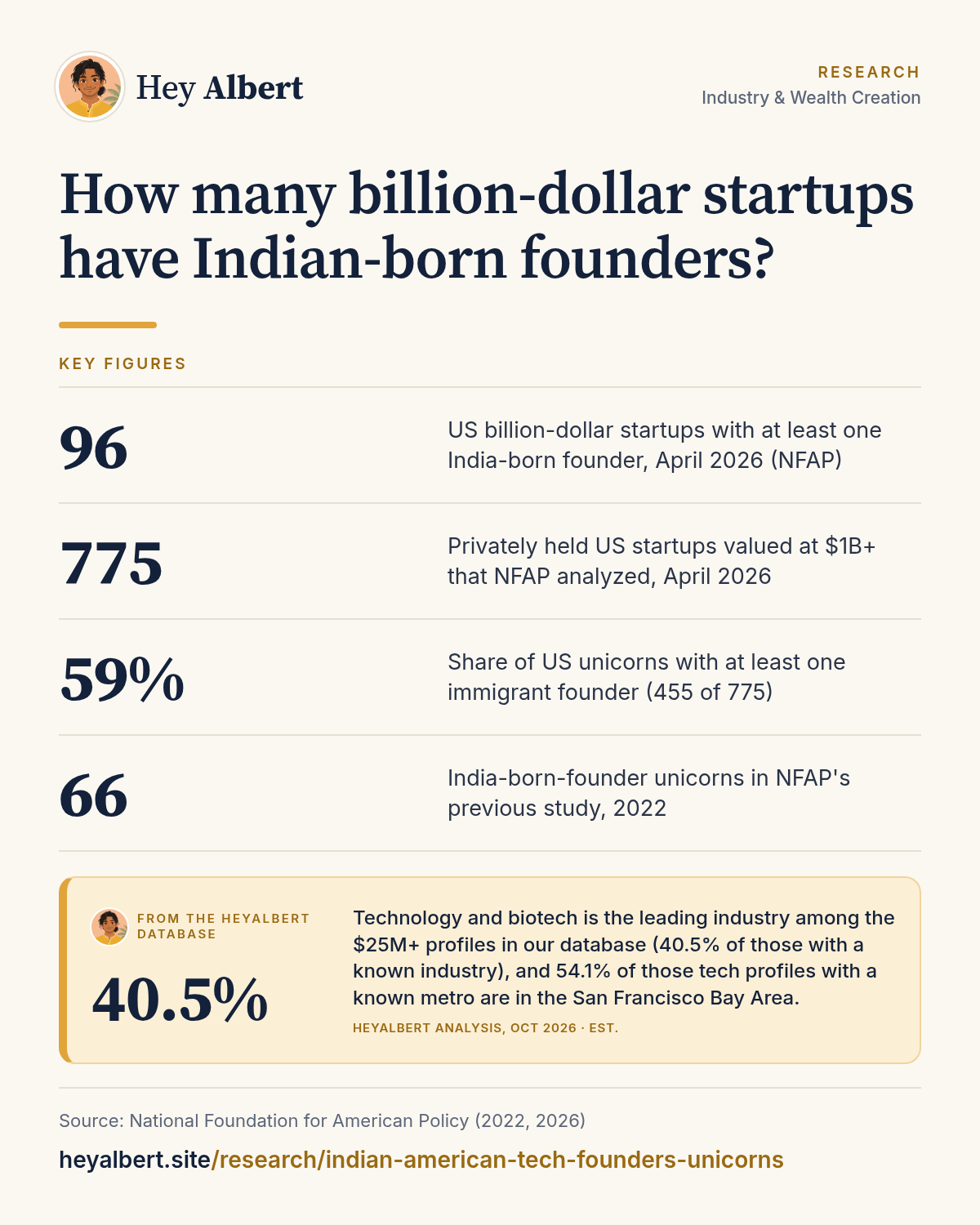
As of April 2026, immigrants born in India had founded or co-founded 96 privately held US startups valued at $1 billion or more, more than immigrants from any other country, according to the National Foundation for American Policy1. That is about one in eight of the 775 US unicorns NFAP counted, and up from 66 companies in its 2022 study1,2.
HeyAlbert data shows technology and biotech is the leading industry among the $25M+ profiles in our database (40.5% of those with a known industry), and 54.1% of those tech profiles with a known metro are in the San Francisco Bay Area. See the data · Methodology
The short answer: India leads every other country
The most detailed public count comes from the National Foundation for American Policy (NFAP), a nonpartisan research group that tracks the founders of every privately held, venture-backed US company valued at $1 billion or more on the CB Insights list. In its June 2026 policy brief, NFAP found that 455 of 775 US unicorns (59%) had at least one immigrant founder or co-founder, as of April 20261.
Immigrant founders came from 76 countries, and India was the leading country of origin, with 96 companies1. Israel was second with 60, followed by the United Kingdom (47), China (41) and Canada (30)1. On NFAP's numbers, India-born founders appear in roughly 12% of all US unicorns and about 21% of the immigrant-founded ones (our calculation from NFAP's counts). These figures count companies, not people, and a company with founders from two countries is counted for each1.
| Country of birth | US unicorns with a founder from that country (2026) |
|---|---|
| India | 96 |
| Israel | 60 |
| United Kingdom | 47 |
| China | 41 |
| Canada | 30 |
Source: NFAP, June 20261.
What HeyAlbert data shows
How the count has grown since 2022
NFAP's previous study, published in July 2022, counted 582 US unicorns, 319 of them (55%) with an immigrant founder. India was already first, with 66 companies2. Four years later the India figure stands at 96, an increase of 30 companies, as the overall unicorn population also grew1,2. NFAP notes that the share of unicorns with at least one immigrant founder rose from 55% in its 2018 and 2022 reports to 59% in 20261.
The rise mirrors a broader pattern covered in our piece on what share of US startups Indian immigrants found: Indian-born founders are concentrated in enterprise software, cloud infrastructure, cybersecurity and, increasingly, AI.
Serial founders: six of the fifteen were born in India
NFAP identified at least 15 immigrants who have founded two or more billion-dollar companies, and six of them were born in India1:
- Mohit Aron: Nutanix and Cohesity
- Jyoti Bansal: AppDynamics and Harness
- Ashutosh Garg: Bloomreach and Eightfold.ai
- Arvind Jain: Rubrik and Glean
- Sachin Nayyar: Securonix and Saviynt
- Ajeet Singh: Nutanix and ThoughtSpot
All are business-software or infrastructure companies, a reminder that much of this wealth is built in categories consumers rarely see. Several of these companies have since gone public; NFAP lists Nutanix (about $10.5 billion market value) and Rubrik (about $9.9 billion) among immigrant-founded unicorns that listed after 20161. For the biggest liquidity events, see our analysis of the largest IPOs and exits by Indian American founders.
Among the highest-valued private companies in NFAP's 2026 table is Perplexity, the AI answer engine co-founded by India-born Aravind Srinivas, valued at $20 billion as of April 20261.
Why India-born founders are so well represented
NFAP's data point to the immigration route as much as to entrepreneurship itself. Almost one in four US unicorns (183 of 775, or 24%) has a founder who first came to America as an international student1. International students account for 80% of full-time graduate students in US computer and information sciences programs and 75% in electrical and computer engineering, according to NFAP's tabulation of National Science Foundation data1.
NFAP also notes there is generally no reliable US visa for foreign nationals to start a company, so most immigrant founders first worked as employees, typically on an H-1B, before founding1. Our explainer on the H-1B visa's role in Indian American wealth covers that path, and the IIT-to-Silicon Valley pipeline traces where many of these founders studied first.
Geography matters too. NFAP found that 243 of the 455 immigrant-founded unicorns (53%) are headquartered in the San Francisco Bay Area1, the region profiled in our Bay Area research.
What this means for wealth
A unicorn valuation is paper wealth until there is a sale, a secondary transaction or an IPO, and founders typically own a minority stake after several funding rounds. Valuation figures should not be read as founders' net worth. Still, NFAP puts the collective value of immigrant-founded unicorns at $5.0 trillion as of 2026, up from $168 billion in 20161. For founders and early employees, the wealth event usually comes through equity; our guides to equity compensation and to Indian American venture capitalists, who often back the next generation of founders, explain how that equity turns into durable family wealth. For the people at the top of that curve, see who the richest Indian Americans are.
Caveats in the data
NFAP counts founders born outside the United States, so US-born children of Indian immigrants are not in the India figure; NFAP counts them separately among 58 unicorns founded by children of immigrants, without a country breakdown in its summary1. The list covers privately held companies only, so companies that have gone public or been acquired drop out. Valuations come from funding rounds as reported to CB Insights and can fall as well as rise.
Frequently asked questions
How many US unicorns were founded by Indian immigrants?
According to the National Foundation for American Policy, 96 privately held US startups valued at $1 billion or more had at least one India-born founder or co-founder as of April 2026, the most of any country.
Which country is second after India for immigrant unicorn founders?
Israel, with 60 US billion-dollar startups, followed by the United Kingdom with 47 and China with 41, according to NFAP's 2026 analysis.
Which Indian-born founders have built more than one unicorn?
NFAP names six: Mohit Aron, Jyoti Bansal, Ashutosh Garg, Arvind Jain, Sachin Nayyar and Ajeet Singh.
Does the count include US-born founders of Indian descent?
No. The 96 figure covers founders born in India. Founders born in the US to immigrant parents are counted separately by NFAP and are not broken out by country of heritage in its summary.
Sources
Figures are from the public sources below, with the data year stated. Estimates are labeled as estimates. Accessed October 24, 2026.
- National Foundation for American Policy, Immigrants and U.S. Billion-Dollar Companies (NFAP Policy Brief, June 2026) (2026). nfap.com ↩ ↩ ↩
- National Foundation for American Policy, Immigrant Entrepreneurs and U.S. Billion-Dollar Companies (NFAP Policy Brief, July 2022) (2022). nfap.com ↩ ↩ ↩