
Insight
Williamson County nearly doubled its Indian-American population in five years
Williamson County's Asian Indian population rose about 95%, from 18,500 to 36,100. Almost all of our 279 people at $1M+ there are in the first band.
Williamson County, north of Austin, has about 36,100 residents of Asian Indian descent, up from about 18,500 in the 2015–2019 survey [1][2]. That is growth of about 95%, close to double. They are now 5.4% of the county [1][3].
The wealth we can see is new and broad: 279 people in our database at $1M+, and fewer than 25 of them at $5M+ [8].
- 36,095 residents of Asian Indian descent (alone or in combination) in Williamson County, Texas, 2020–2024 average [1], or 5.4% of the population [3].
- +95.1% versus the 2015–2019 estimate of 18,499 [1][2] (our calculation).
- 279 people in the HeyAlbert database placed in Williamson County, Texas at an estimated $1M+, of whom <25 are in our $5M+ bands [8].
Where Williamson County, Texas's Indian-American residents live, by place
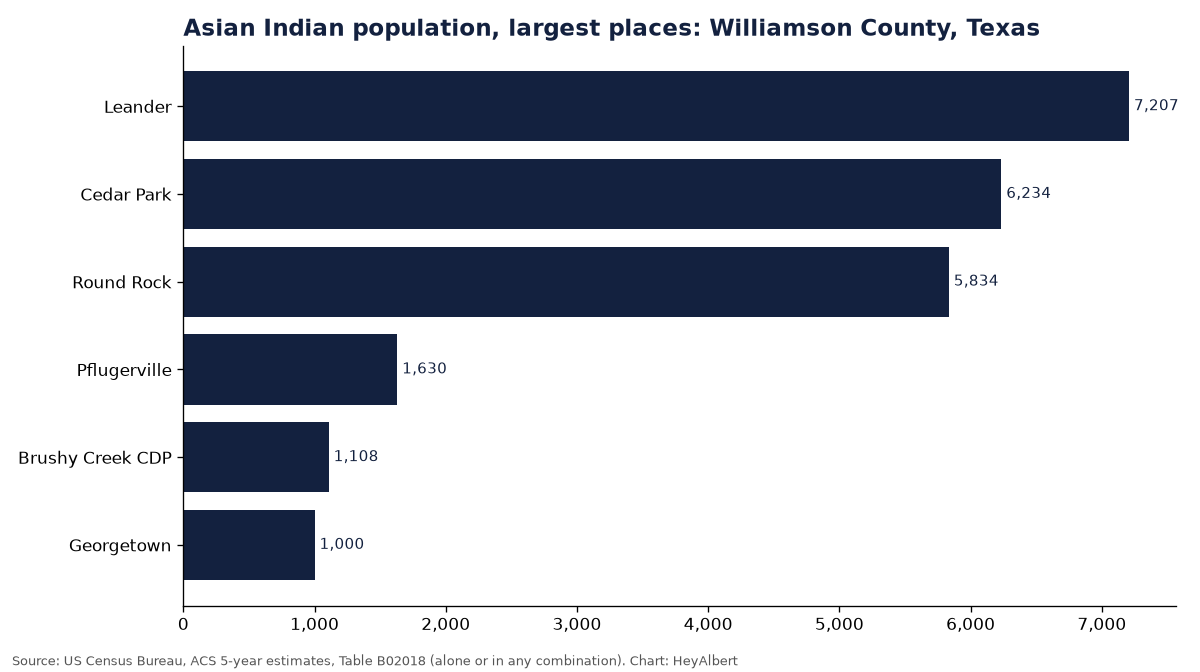
The Census Bureau's American Community Survey counts 36,095 people who report Asian Indian ancestry, alone or with another group, in Williamson County, Texas [1]. Leander is the largest community, with 20% of the county total [4]–[7] (our calculation).
| Place | Asian Indian residents | Share of place |
|---|---|---|
| Leander | 7,207 | 9.7% |
| Cedar Park | 6,234 | 8.0% |
| Round Rock | 5,834 | 4.6% |
| Pflugerville | 1,630 | 2.5% |
| Brushy Creek CDP | 1,108 | 5.7% |
| Georgetown | 1,000 | 1.2% |
Asian Indian alone or in any combination. Sources: ACS 5-year estimates [4]–[7]; totals from Table B01003. Change and share are our calculations. Estimates carry margins of error.
Leander has about 7,200 residents of Asian Indian descent, 10% of the city [4]–[7]. Cedar Park has about 6,200 (8%) and Round Rock about 5,800 (5%) [4]–[7]. Brushy Creek and Santa Rita Ranch add smaller, concentrated communities [4]–[7].
What the HeyAlbert database shows in Williamson County, Texas
HeyAlbert builds profiles of Indian-American individuals with an estimated net worth of $1M or more from public records, and every estimate is tied to a cited source. Our database currently places 279 such people in Williamson County, Texas [8]. That is a count of people we have found and estimated, not a census of wealthy households: our coverage is partial and uneven.
| Estimated net-worth band | People in our database |
|---|---|
| $1M–5M | 267 |
| $5M–15M | <25 |
| $25M+ (probable) | <25 |
| $25M+ (likely) | <25 |
| Total, $1M+ | 279 |
Source: HeyAlbert database [8]. Bands are estimates from public evidence; “likely” and “probable” describe our confidence in the $25M+ tier. Cells under 25 are suppressed.
| City | $1M+ | of which $5M+ | of which $25M+ |
|---|---|---|---|
| Cedar Park | 96 | <25 | <25 |
| Leander | 88 | <25 | <25 |
| Round Rock | 55 | <25 | <25 |
| Georgetown | 26 | <25 | <25 |
Source: HeyAlbert database [8]. Cities with 25+ people at $1M+; cells under 25 shown as <25. The city is where our sources place the person; for some records it is a workplace rather than a home. Cities in our database are matched by name to the Census places and townships in the county; a few that straddle a county line are counted whole, and large cities that extend well beyond the county are left out.
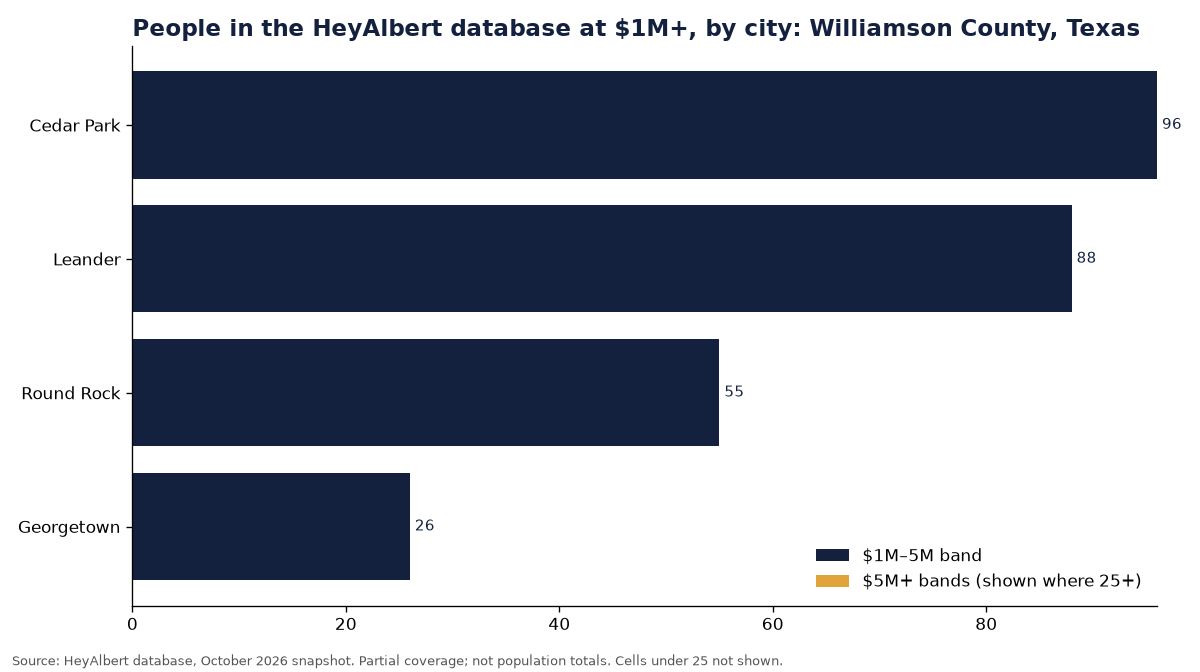
Of our 279 people, 267 are in the $1M–5M band [8]. Cedar Park has 96 people in our set, Leander 88, Round Rock 55 and Georgetown 26 [8]. Each has fewer than 25 at $5M+ [8].
Why our Williamson County, Texas count looks the way it does
Each estimate in our database rests on a primary piece of public evidence. The mix differs from place to place, depending on which records we have been able to process, and it shapes the counts above more than any real difference in wealth does [8].
| Primary evidence for the estimate | People | Share |
|---|---|---|
| Home value (public assessor or listing records) | 266 | 95% |
Source: HeyAlbert database [8], people at $1M+. Categories under 25 not shown.
Home values support 266 of our 279 estimates [8]. This is home-equity wealth, and our count includes only homes above our value threshold, so many recent buyers are not yet in it.
What it means if you work with these families
Williamson is one of the clearest growth stories in our county series. For advisors and nonprofits, the opportunity is early: families building equity in Leander, Cedar Park and Round Rock, with most of their wealth decisions still ahead.
Methodology
Census figures are American Community Survey 5-year estimates for 2020–2024 and 2015–2019, Table B02018, using “Asian Indian, alone or in any combination” [1][2]. Total population comes from Table B01003 [3]. The Census Bureau changed how it codes detailed race responses in 2020, so part of the change between the two periods may reflect coding rather than migration. All estimates carry margins of error. Shares and growth rates are our calculations.
HeyAlbert counts are aggregates from our database as of October 2026 [8]. They include people we identified as likely of Indian origin with an estimated net worth of $1M or more, based on public records such as property assessments, professional licenses, patents, SEC filings and donor rolls. Coverage is partial and depends on which public records exist and which we have processed. These counts are not population totals. Any cell under 25 is suppressed, and we publish aggregates only, never individual records.
Related
- Indian-American wealth in Austin
- Indian-American wealth in Texas
- The fastest-growing Indian-American counties
- What is the average net worth of an Indian American household?
HeyAlbert finds Indian-American families worth $1M+ and tells you who to call, with every fact cited. See who is in Williamson County, Texas at heyalbert.site.
Sources
- ACS 2020–2024 5-year estimates, Table B02018, all counties. US Census Bureau. https://data.census.gov/table/ACSDT5Y2024.B02018?g=010XX00US$0500000 (data: machine-readable)
- ACS 2015–2019 5-year estimates, Table B02018, all counties. US Census Bureau. https://data.census.gov/table/ACSDT5Y2019.B02018?g=010XX00US$0500000 (data: machine-readable)
- ACS 2020–2024 5-year estimates, Table B01003, all counties. US Census Bureau. https://data.census.gov/table/ACSDT5Y2024.B01003?g=010XX00US$0500000 (data: machine-readable)
- ACS 2020–2024 5-year estimates, Table B02018, places in Williamson County, Texas. US Census Bureau. https://data.census.gov/table/ACSDT5Y2024.B02018?g=050XX00US48491$1600000 (data: machine-readable)
- ACS 2020–2024 5-year estimates, Table B01003, places in Williamson County, Texas. US Census Bureau. https://data.census.gov/table/ACSDT5Y2024.B01003?g=050XX00US48491$1600000 (data: machine-readable)
- ACS 2020–2024 5-year estimates, Table B02018, county subdivisions in Williamson County, Texas. US Census Bureau. https://data.census.gov/table/ACSDT5Y2024.B02018?g=050XX00US48491$0600000 (data: machine-readable)
- ACS 2020–2024 5-year estimates, Table B01003, county subdivisions in Williamson County, Texas. US Census Bureau. https://data.census.gov/table/ACSDT5Y2024.B01003?g=050XX00US48491$0600000 (data: machine-readable)
- HeyAlbert database, aggregate counts (October 2026 snapshot); how we build it is described on our methodology page. HeyAlbert. https://heyalbert.site/research/methodology/
See the data before you talk to us
Read a full sample report to judge the depth and sourcing, then book a walkthrough with your own use case.