
Short answer
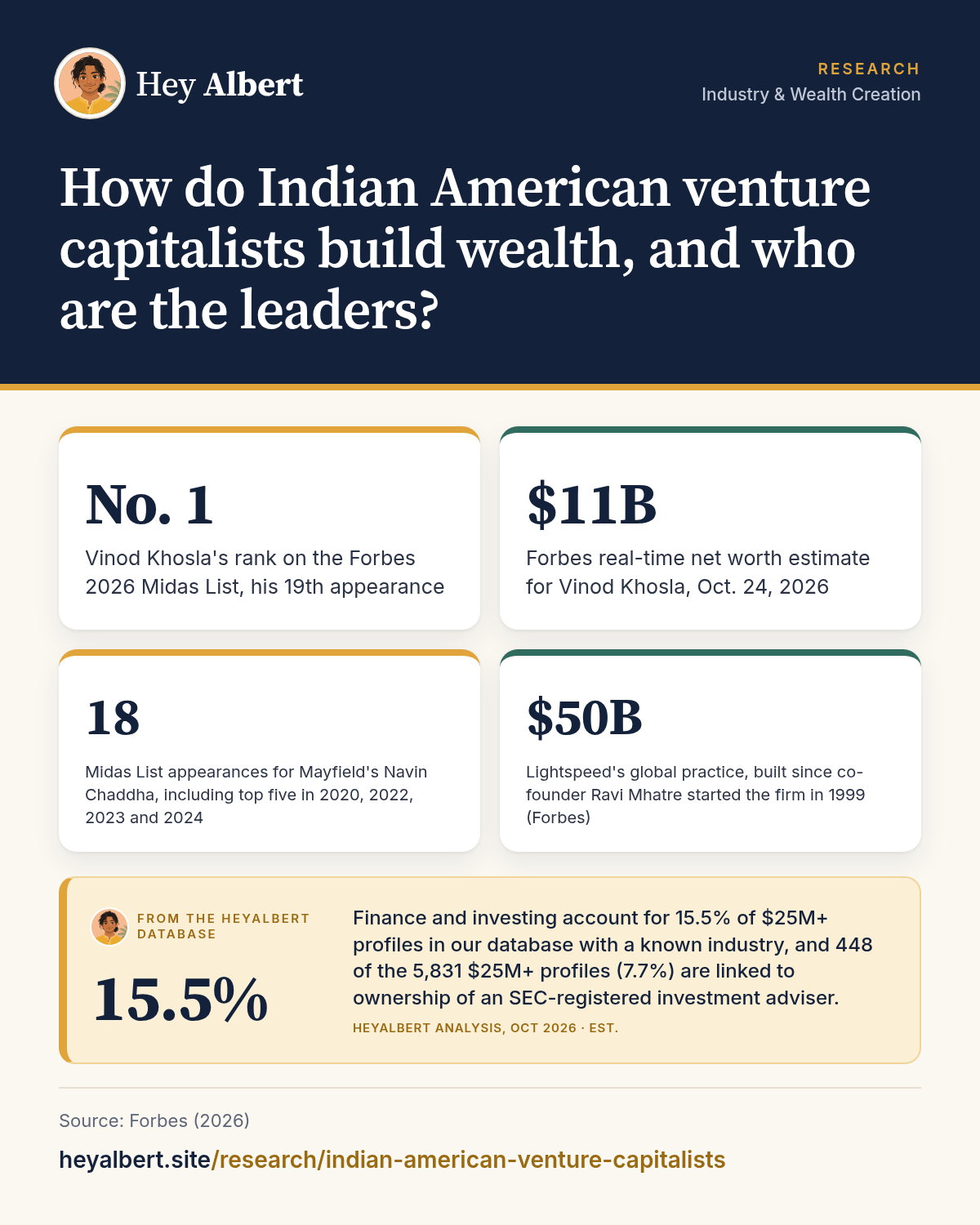
Indian American venture capitalists typically build wealth in two stages: first as founders or operators who earn equity in successful companies, then as investors who share in the profits of the funds they manage. The most prominent example is Vinod Khosla, the Sun Microsystems co-founder who ranks No. 1 on Forbes' 2026 Midas List and whose net worth Forbes estimated at $11 billion in October 20261.
HeyAlbert data shows finance and investing account for 15.5% of $25M+ profiles in our database with a known industry, and 448 of the 5,831 $25M+ profiles (7.7%) are linked to ownership of an SEC-registered investment adviser. See the data · Methodology
The leaders: a short list from public sources
Forbes' Midas List, produced with data partner TrueBridge, ranks the world's top 100 venture investors by realized and paper returns2. Several of its perennial names are Indian American. Here are three whose backgrounds are documented in their Forbes profiles or firm biographies:
- Vinod Khosla, Khosla Ventures. Ranked No. 1 on the 2026 Midas List, his 19th appearance. He co-founded Sun Microsystems in 1982, spent 18 years at Kleiner Perkins and then started his own firm, which Forbes says was the first venture firm to invest in OpenAI. Forbes lists him as a self-made, IIT-educated billionaire who immigrated from India in the 1970s, with a real-time net worth of $11 billion as of October 24, 20261.
- Navin Chaddha, Mayfield. An 18-time Midas List honoree, ranked in the top five in 2020, 2022, 2023 and 20243. He has backed 18 companies that went public, including Lyft and HashiCorp3,6. Mayfield says his investments have created more than $120 billion in equity value; he studied at IIT Delhi and Stanford6.
- Ravi Mhatre, Lightspeed Venture Partners. Co-founded Lightspeed in 1999 and built its $50 billion global practice; his portfolio includes Rubrik, MuleSoft and AppDynamics, and he led Lightspeed's investment in Anthropic. Forbes describes him as the son of an Indian immigrant and a Brooklyn native4.
These are illustrations drawn from public profiles, not a ranking of all Indian American investors. For individual fortunes more broadly, see who the richest Indian Americans are.
What HeyAlbert data shows
Stage one: operator equity
Many leading Indian American VCs were engineers and founders first. Khosla co-founded Sun Microsystems before turning to venture capital1; Chaddha co-founded or led three startups, including VXtreme, a streaming media platform that Microsoft acquired and turned into Windows Media, according to his firm biography6. He is also described by Mayfield as one of the earliest Silicon Valley investors to back technology in India, with early investments including MakeMyTrip6. Cross-border ties of this kind are common among Indian American investors, who often back companies in both countries. That path mirrors the wider pattern documented in the share of US tech startups founded by Indian immigrants: technical training, years inside fast-growing companies, then equity in a company of one's own. The equity mechanics that turn employee or founder stock into wealth are explained in how equity compensation drives Indian American wealth.
Stage two: fund economics
As investors, venture capitalists earn in three ways. Management fees, charged on the capital a fund raises, pay salaries and firm costs. Carried interest, a share of the fund's profits after investors get their money back, is where large fortunes are made when a fund backs a breakout company. And partners invest their own money alongside the fund, so their personal stakes rise with the portfolio. A single exceptional company can define a career: Forbes notes that when Rubrik went public in 2024, Greylock's stake alone more than returned the $1 billion fund that held it7.
Because returns depend on rare outliers, wealth in venture capital is highly concentrated among the most successful partners. Those outliers increasingly include AI companies, where Forbes credits Khosla Ventures with the first venture investment in OpenAI and Lightspeed with leading rounds in Anthropic1,4.
A pipeline of Indian-born founders
Indian American investors benefit from, and help build, a deep pipeline of founders. The National Foundation for American Policy counts 96 US unicorns with an India-born founder as of April 2026, more than any other country, including serial founders such as Jyoti Bansal, Arvind Jain and Mohit Aron5. Several of the companies in these investors' portfolios, such as Rubrik and AppDynamics, were founded by Indian-born entrepreneurs4,5. See how many billion-dollar startups have Indian-born founders for the full picture.
Earlier-stage capital often comes from angel networks and community organizations; see Indian American angel investors and TiE Angels and professional networks like TiE. Where these investors cluster is covered in Indian Americans in Silicon Valley.
From carry to family wealth
Successful VCs tend to accumulate concentrated, illiquid holdings: fund interests, co-investments and stock distributed after IPOs. Turning that into durable family wealth involves diversification, tax planning around distributions and, at the top end, family offices and foundations. Those themes are covered in how wealthy Indian Americans run family offices. Philanthropy often follows: Mayfield, for example, describes Chaddha as an active philanthropist focused on education, opportunity for underrepresented communities and food insecurity6.
Frequently asked questions
Who is the most successful Indian American venture capitalist?
By Forbes' measure, Vinod Khosla of Khosla Ventures, who ranks No. 1 on the 2026 Midas List of top venture investors and has a Forbes-estimated net worth of about $11 billion.
How do venture capitalists make money?
Through management fees on the funds they raise, carried interest (a share of fund profits after investors are repaid) and returns on their own money invested alongside the fund.
Which Indian American VCs appear on the Midas List?
Perennial honorees include Vinod Khosla of Khosla Ventures, Navin Chaddha of Mayfield, an 18-time honoree, and Ravi Mhatre, co-founder of Lightspeed Venture Partners.
Were most Indian American VCs founders first?
Many were. Vinod Khosla co-founded Sun Microsystems, and Navin Chaddha co-founded or led three startups before becoming a full-time investor.
Sources
Figures are from the public sources below, with the data year stated. Estimates are labeled as estimates. Accessed October 24, 2026.
- Forbes, Vinod Khosla (profile) (2026). forbes.com ↩ ↩ ↩
- Forbes, Forbes 2026 Midas List: Top Venture Capital Investors Ranked (2026). forbes.com ↩
- Forbes, Navin Chaddha (profile) (2026). forbes.com ↩ ↩ ↩
- Forbes, Ravi Mhatre (profile) (2026). forbes.com ↩ ↩ ↩
- National Foundation for American Policy, Immigrants and U.S. Billion-Dollar Companies (NFAP Policy Brief, June 2026) (2026). nfap.com ↩ ↩ ↩
- Mayfield, Navin Chaddha, Managing Partner (biography) (2026). mayfield.com ↩ ↩ ↩
- Forbes, Asheem Chandna (profile) (2026). forbes.com ↩