
Short answer
New Jersey has the highest concentration of Indian Americans of any state: 448,588 people identified as Asian Indian alone in 2024, 4.7% of the population1,2. Middlesex County is the core of that community, with 150,831 Asian Indian residents (16.9% of the county) and a median household income of $189,7643. The cluster grew from a 1970s settlement along Oak Tree Road in Edison and Iselin, near New York's job market and the state's pharmaceutical, finance and technology employers5.
HeyAlbert data shows New Jersey holds 4.9% of $5–15M profiles and 3.6% of $25M+ profiles in our database with a known state, and IT services and staffing is the most common industry among New Jersey's $25M+ profiles with a known industry. See the data · Methodology
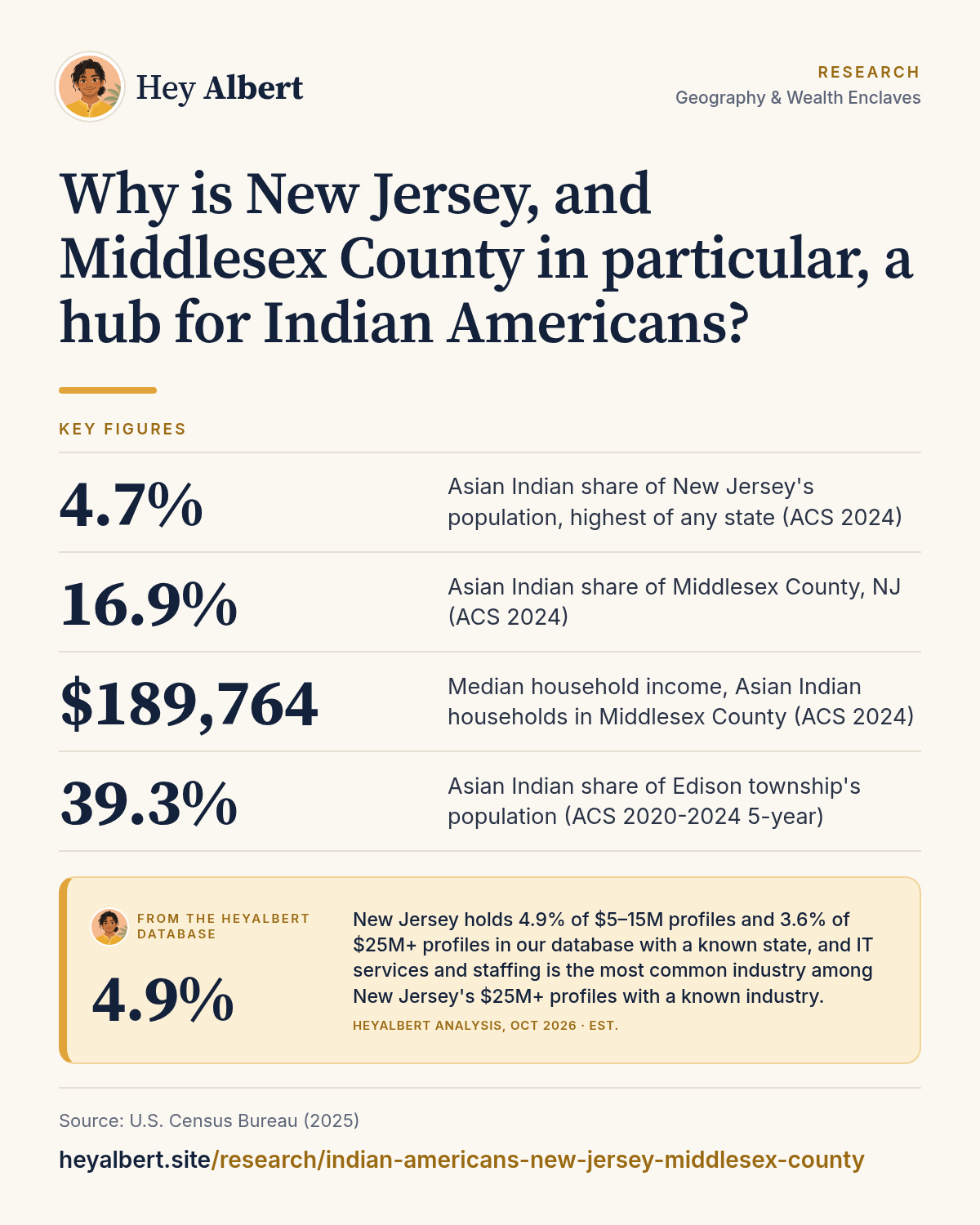
New Jersey by the numbers
New Jersey ranks third among states for its Asian Indian population, behind California and Texas, but first for concentration. In 2024, 448,588 New Jersey residents identified as Asian Indian alone, 4.7% of the state's population1,2. Their median household income was $188,317, compared with $104,294 for all New Jersey households1,2. The population grew about 17% between 2019 and 2024, our calculation from ACS 1-year estimates (384,988 to 448,588)1,7.
The Migration Policy Institute (MPI) estimates that New Jersey is home to about 10% of all Indian immigrants in the US, based on pooled 2020-24 Census data6. For how New Jersey compares nationally, see our ranking of states with the largest and wealthiest Indian American populations.
What HeyAlbert data shows
Middlesex County: the center of gravity
Middlesex County, in central New Jersey, had 150,831 Asian Indian residents in 2024, the third-largest county population in the country after Santa Clara and Alameda counties in California3. At 16.9% of the county, it is the highest share among the counties the Census Bureau publishes3. MPI lists Middlesex with Santa Clara, Alameda and King County, Washington, as the four top counties for Indian immigrants; together they hold about 15% of all Indian immigrants in the US6.
- Median household income: $189,764 for Asian Indian households, against $115,040 for all county households3
- Bachelor's degree or higher: 82.7% of Asian Indian adults 25 and older; 43.5% hold a graduate or professional degree3
- Homeownership: 67.7%, with a median home value of $679,0003
The county's Asian Indian population grew from 130,295 in 2019 to 150,831 in 2024, about 16%3,10.
These figures describe a broadly affluent, highly educated community rather than a small group of very wealthy households. The county's Asian Indian per capita income was $65,291 in 2024, below the national Asian Indian figure of $76,212, in part because households are larger: an average of 3.23 people per Asian Indian household in Middlesex, against 2.85 nationally3,9. We look at that household structure in multigenerational living in Indian American households.
The towns: Edison, Plainsboro and South Brunswick
Within Middlesex, the Census Bureau's 2020-2024 five-year estimates show several municipalities where Asian Indians are more than a third of residents4:
| Municipality | Asian Indian residents | Share of population |
|---|---|---|
| Edison township | 42,521 | 39.3% |
| South Brunswick township | 17,797 | 37.8% |
| Woodbridge township (includes Iselin) | 16,352 | 15.7% |
| Piscataway township | 11,636 | 19.0% |
| Monroe township | 11,240 | 22.9% |
| Plainsboro township | 9,886 | 40.9% |
ACS 2020-2024 5-year estimates, Asian Indian alone; shares are our calculation against total population4. Five-year figures carry margins of error of several hundred to about 2,000 people for these towns.
How it started: Oak Tree Road
The roots are in the 1970s. According to a PBS documentary from New York's WNET, immigrants from India began settling along Oak Tree Road in Iselin and Edison in that decade, and the community grew rapidly through the 1980s and 1990s5. The area had already been suburbanizing: the Garden State Parkway opened in 1957 and the Metropark train station, on the Northeast Corridor line to New York, opened in 19715.
Over time the corridor became one of the country's best-known South Asian commercial districts, with restaurants, jewelers and clothing stores, which in turn made the area attractive to new arrivals. Many of these were family businesses, many of them serving family celebrations such as weddings (see Indian American wedding spending), a pattern we explore in the role of family-owned businesses in Indian American wealth.
Why it kept growing: jobs within commuting distance
Central New Jersey sits within commuting distance of New York City's finance and professional-services jobs and of the state's large pharmaceutical, healthcare and technology employers. Census data on the wider New York metro area show what that means for Asian Indian workers: 16.2% work in finance, insurance and real estate, and 23.9% in education and health care, both above the national shares for all workers of 6.5% and 23.8%8,9.
Many also came through IT consulting and staffing firms headquartered or active in the region, a sector we cover in Indian American-owned IT services firms. Healthcare is another pillar; see Indian American doctors and physicians.
New Jersey within the New York metro
Middlesex County is part of the New York-Newark-Jersey City metro area, which had 709,466 Asian Indian residents in 2024, the largest of any US metro8. The metro's Asian Indian median household income was $164,130, lower than New Jersey's statewide figure, partly because it includes Queens, where the long-established community has lower median incomes ($94,440) than in suburban New Jersey3,8. We break that down in our profile of the New York metro area, and compare metros in the most affluent Indian American metro areas.
Frequently asked questions
Which New Jersey town has the most Indian Americans?
Edison township, with about 42,500 Asian Indian residents, about 39% of its population, according to Census Bureau 2020-2024 five-year estimates. Plainsboro and South Brunswick also have shares near or above 38%.
How many Indian Americans live in New Jersey?
About 449,000 people identified as Asian Indian alone in New Jersey in 2024, 4.7% of the state's population, the highest share of any state.
What is the median income of Indian Americans in Middlesex County?
About $189,800 for Asian Indian households in 2024, compared with about $115,000 for all households in the county, according to the American Community Survey.
Why did Indian immigrants settle in Edison and Iselin?
Immigrants from India began settling along Oak Tree Road in the 1970s in an area with new suburban housing and rail links to New York. The community and its businesses grew through the 1980s and 1990s, drawing further arrivals.
Sources
Figures are from the public sources below, with the data year stated. Estimates are labeled as estimates. Accessed October 24, 2026.
- US Census Bureau, S0201 Selected Population Profile, Asian Indian alone, by state (ACS 2024 1-year) (2025). data.census.gov ↩ ↩ ↩
- US Census Bureau, S0201 Selected Population Profile, total population, by state (ACS 2024 1-year) (2025). data.census.gov ↩ ↩ ↩
- US Census Bureau, S0201 Selected Population Profile, Asian Indian alone and total population, by county (ACS 2024 1-year) (2025). data.census.gov ↩ ↩ ↩
- US Census Bureau, B02015 Asian Alone by Selected Groups and B01003 Total Population, Middlesex County NJ county subdivisions (ACS 2020-2024 5-year) (2025). data.census.gov ↩ ↩ ↩
- PBS / WNET, THIRTEEN Specials: Destination Oak Tree Road (2024). pbs.org ↩ ↩ ↩
- Migration Policy Institute, Indian Immigrants in the United States (2026). migrationpolicy.org ↩ ↩ ↩
- US Census Bureau, S0201 Selected Population Profile, Asian Indian alone, by state (ACS 2019 1-year) (2020). data.census.gov ↩
- US Census Bureau, S0201 Selected Population Profile, Asian Indian alone, by metro area (ACS 2024 1-year) (2025). data.census.gov ↩ ↩ ↩
- US Census Bureau, S0201 Selected Population Profile, total population, United States (ACS 2024 1-year) (2025). data.census.gov ↩ ↩
- US Census Bureau, S0201 Selected Population Profile, Asian Indian alone, by county (ACS 2019 1-year) (2020). data.census.gov ↩