
Short answer
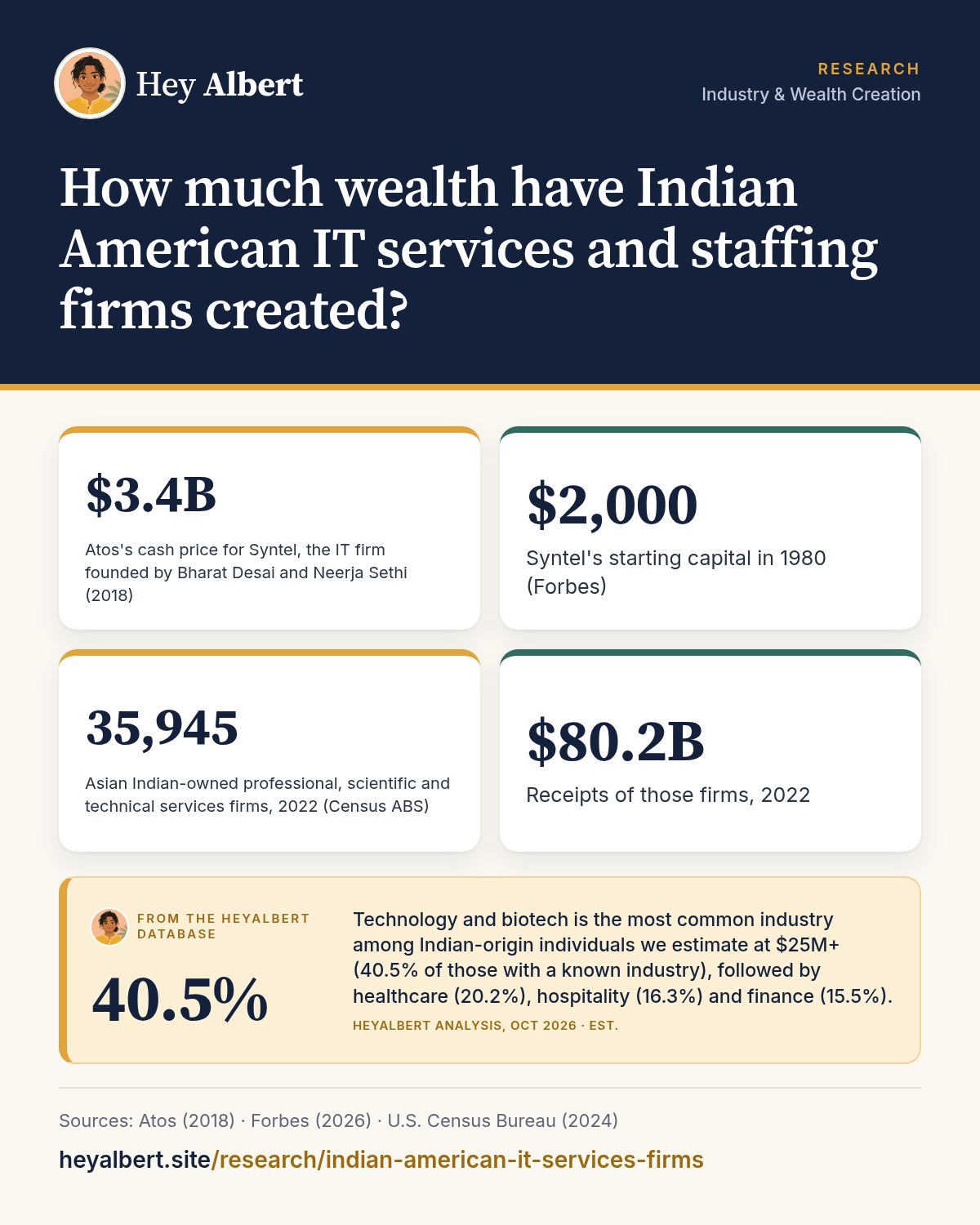
IT services and staffing have produced some of the clearest Indian American business fortunes. Syntel, founded in 1980 by Bharat Desai and Neerja Sethi with $2,000, was sold to Atos in 2018 for about $3.4 billion, and Forbes now estimates each founder's net worth above $1 billion1,2,3. More broadly, Asian Indian Americans owned 35,945 professional, scientific and technical services firms in 2022, with $80.2 billion in receipts4.
HeyAlbert data shows technology and biotech is the most common industry among Indian-origin individuals we estimate at $25M+ (40.5% of those with a known industry), followed by healthcare (20.2%), hospitality (16.3%) and finance (15.5%). See the data · Methodology
How the industry took shape
Indian American IT services firms grew out of a simple arbitrage: US companies needed programmers and systems work, and a deep pool of engineers trained in India could supply it, first on site in the US and later from offshore delivery centers. The model was pioneered by large Indian firms such as Tata Consultancy Services, and Indian American entrepreneurs built US-headquartered versions of it.
The H-1B visa was central. In fiscal 2025, 62% of approved H-1B beneficiaries worked in computer-related occupations, and 70% were born in India5. Pew Research Center reports that IT and outsourcing firms have long been among the largest H-1B sponsors: in 2023 three of the top 10 were Infosys and Tata Consultancy Services, both headquartered in India, and Cognizant, which originated in India and is now headquartered in the US6. The visa's role is covered in the H-1B visa and Indian American wealth.
What HeyAlbert data shows
Case study: Syntel
Syntel is the best-documented example of an Indian American IT services fortune. According to Forbes, Bharat Desai and Neerja Sethi met in the US while working for Tata Consultancy Services and founded Syntel from their apartment in Troy, Michigan in 1980 with $2,0001,2. The company generated $30,000 in sales in its first year and grew to more than $900 million in annual revenue before its sale1. Syntel went public in 1997, and Sethi served as an executive from its founding until the 2018 sale2. Forbes also reports that Atos later sued Desai, accusing him of hiding liabilities ahead of the merger, and that the case was dismissed in 20231.
In July 2018, Atos agreed to acquire Syntel for about $3.4 billion in cash, or $41 per share, bringing roughly $1 billion of revenue and 23,000 employees into the French group3. Forbes estimates Sethi received about $510 million for her stake2, and as of October 24, 2026 put Desai's net worth at $1.6 billion and Sethi's at $1.2 billion1,2. Desai, Forbes notes, was born in Kenya, raised in India and came to the US in 1976 as a programmer for Tata1. In May 2025 the couple joined the Giving Pledge, committing to give away at least half their fortune2; that kind of giving is discussed in Indian American philanthropy.
The broader footprint in Census data
Most Indian American IT firms are far smaller than Syntel. The Census Bureau does not publish a separate count for IT consulting by owner race at the national summary level, but its Annual Business Survey shows that in 2022 Asian Indian Americans owned 35,945 employer firms in professional, scientific and technical services, a sector that includes computer systems design and IT consulting along with engineering, accounting and legal practices4. Those firms reported $80.2 billion in receipts and employed 345,026 people4. Another 2,700 Asian Indian-owned firms were in the information sector, with $15.0 billion in receipts4.
| Sector, Asian Indian-owned (2022) | Firms | Receipts | Employees |
|---|---|---|---|
| Professional, scientific and technical services | 35,945 | $80.2B | 345,026 |
| Information | 2,700 | $15.0B | 53,251 |
| Administrative and support services (incl. staffing) | 4,339 | $17.4B | 133,317 |
Source: US Census Bureau, Annual Business Survey 20224. For all sectors, see how many businesses Indian Americans own.
How the wealth is made, and kept
IT services firms are people businesses. Owners earn the spread between what clients pay for a consultant's time and what the consultant costs, so wealth scales with headcount, utilization and the move from staff augmentation into higher-margin projects and managed services. Atos highlighted Syntel's operating margin of about 24% and its digital services, around 40% of revenue, as reasons for the deal3.
The largest payoffs come at a sale or IPO. Owners then face the familiar questions of diversifying a concentrated position, managing taxes and structuring family wealth, topics covered in Indian American family offices and family businesses in Indian American wealth creation.
Headwinds
The model faces pressure. The September 2025 presidential proclamation requiring a $100,000 payment with most new H-1B petitions for workers outside the US raised the cost of the traditional on-site staffing model, and Pew notes the number of India-linked firms among the top 10 H-1B employers fell from six in 2016 to three in 20236,7. Automation and AI tools are also reshaping demand for routine coding and testing. Many founders have responded by moving into software products or investing in startups, a path described in Indian immigrant-founded startups. For context on the community's economic weight, see how much Indian Americans contribute to the US economy.
Frequently asked questions
Which Indian American founders got rich from IT services?
A well-documented example is Syntel, founded in 1980 by Bharat Desai and Neerja Sethi and sold to Atos for about $3.4 billion in 2018. Forbes estimates both founders are billionaires.
How many IT and professional services firms do Indian Americans own?
Asian Indian Americans owned 35,945 employer firms in professional, scientific and technical services in 2022, with $80.2 billion in receipts, according to the Census Bureau. That sector includes IT consulting as well as engineering, accounting and legal firms.
Why are IT services firms linked to the H-1B visa?
The firms have relied on skilled foreign engineers, and IT and outsourcing companies have long been among the largest H-1B sponsors. In fiscal 2025, 62% of approved H-1B workers were in computer-related jobs.
Is the IT staffing model changing?
Yes. A $100,000 payment now required for most new H-1B petitions, plus automation and AI, are pushing firms toward offshore delivery, software products and higher-value services.
Sources
Figures are from the public sources below, with the data year stated. Estimates are labeled as estimates. Accessed October 24, 2026.
- Forbes, Bharat Desai (profile) (2026). forbes.com ↩ ↩ ↩
- Forbes, Neerja Sethi (profile) (2026). forbes.com ↩ ↩ ↩
- Atos, Atos to acquire Syntel (press release, July 22, 2018) (2018). atosgroup.com ↩ ↩ ↩
- US Census Bureau, Annual Business Survey: Statistics for Employer Firms by Industry, Sex, Ethnicity, Race, and Veteran Status for the U.S.: 2022 (AB2200CSA01) (2024). data.census.gov ↩ ↩ ↩
- US Citizenship and Immigration Services, Characteristics of H-1B Specialty Occupation Workers, Fiscal Year 2025 Annual Report to Congress (2026). uscis.gov ↩ ↩
- Pew Research Center, What we know about the U.S. H-1B visa program (2025). pewresearch.org ↩ ↩
- The White House, Restriction on Entry of Certain Nonimmigrant Workers (proclamation extending the 2025 H-1B restriction) (2026). whitehouse.gov ↩