
Short answer
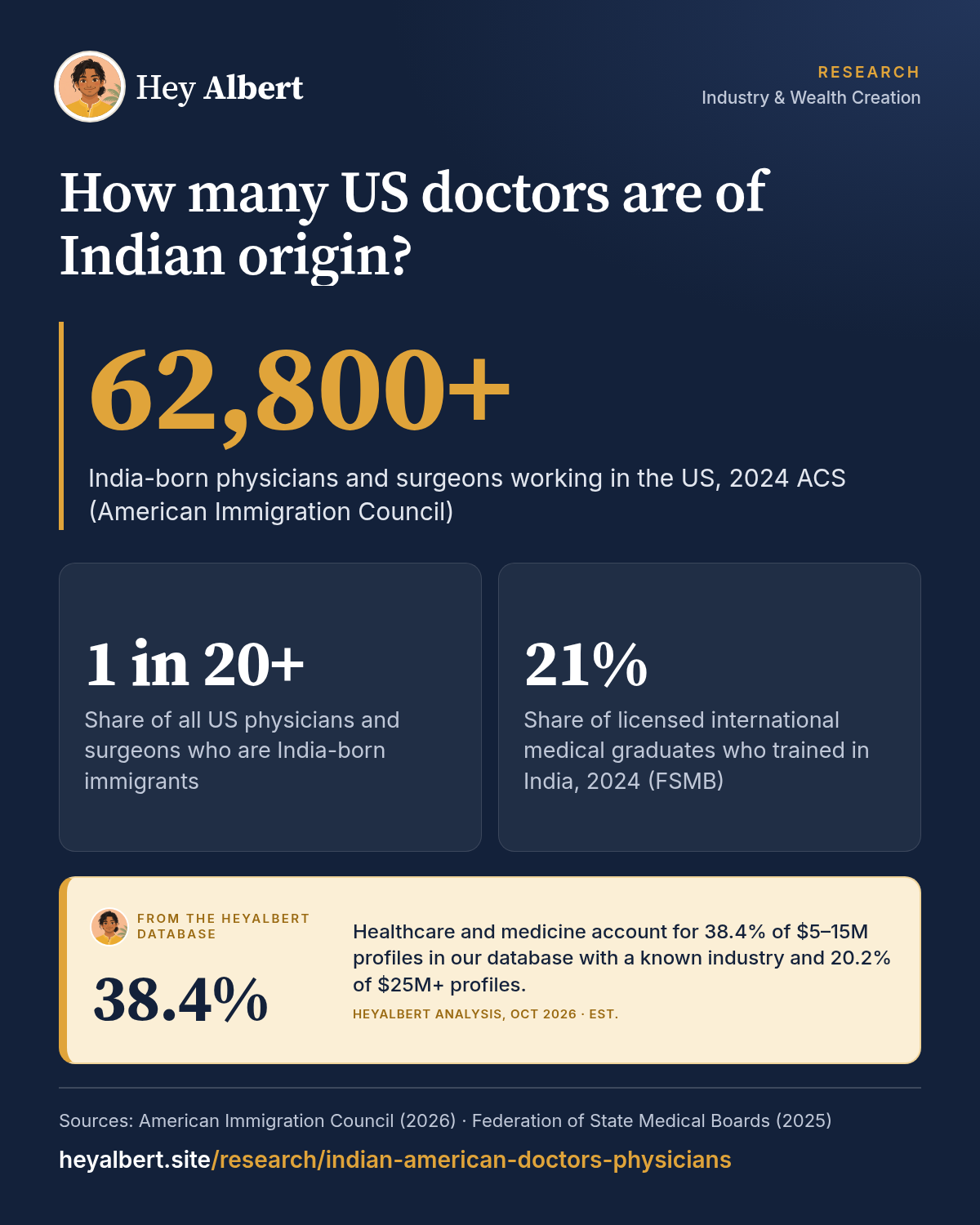
More than 62,800 physicians and surgeons working in the US were born in India, according to the American Immigration Council's analysis of 2024 Census data, which makes India the leading country of birth for immigrant doctors and puts India-born physicians at more than 1 in 20 US doctors1. Counting US-born doctors of Indian descent would raise that figure, but no official source publishes a combined total.
HeyAlbert data shows healthcare and medicine account for 38.4% of $5–15M profiles in our database with a known industry and 20.2% of $25M+ profiles. See the data · Methodology
The best available count
There is no official registry of physicians by ancestry, so the number depends on how "Indian origin" is defined. The most reliable figure counts doctors born in India. Using the 2024 American Community Survey, the American Immigration Council (AIC) found more than 62,800 India-born physicians and surgeons in the US workforce, by far the largest group among immigrant doctors1. AIC says Indian immigrants make up more than 1 in 20 US physicians and surgeons1.
That count leaves out a large group: doctors born in the US to Indian immigrant parents. They are recorded by the Census as Asian Indian by race rather than by birthplace, and no public table isolates them as physicians. So the total number of doctors of Indian origin is higher than 62,800, but any precise national total you see without a cited data source should be treated with caution. The largest professional body, the American Association of Physicians of Indian Origin (AAPI), describes itself as the voice of more than 16,000 physicians of Indian origin, a count of its own members rather than of all such doctors4.
What HeyAlbert data shows
What medical licensing data show
A second lens comes from the Federation of State Medical Boards (FSMB), which counts every actively licensed physician. Its 2024 census found 1,082,187 licensed physicians, 23% of them international medical graduates (IMGs), meaning they earned their medical degree outside the US and Canada2. Among licensed IMGs, 21% graduated from medical schools in India, second only to schools in the Caribbean at 23%2.
On those figures, graduates of Indian medical schools are roughly 4.8% of all licensed US physicians, or about 50,000 doctors (our calculation from FSMB's percentages). Like the AIC figure, this undercounts doctors of Indian heritage, since it excludes anyone who studied medicine in the US.
| Measure | Figure | Source |
|---|---|---|
| India-born physicians and surgeons (2024) | 62,800+ | AIC, 2024 ACS1 |
| Licensed physicians, all (2024) | 1,082,187 | FSMB2 |
| IMGs as share of licensed physicians | 23% | FSMB2 |
| India's share of licensed IMGs | 21% | FSMB2 |
| Asian share of active physicians (2024) | 19.8% | AAMC3 |
For broader context, the Association of American Medical Colleges reports that 19.8% of active US physicians identified as Asian in 2024; that category spans many national origins and is not broken out for Indian Americans in its key findings3.
Beyond physicians: India's wider health-care footprint
Doctors are only part of the story. AIC's analysis of the same 2024 Census data counts almost 197,700 India-born health-care workers in the US, making India the third most common country of birth for immigrant health-care workers overall, after the Philippines and Mexico1. Immigrants as a whole make up at least one in six US health-care workers (18.8%)1. India's footprint is heavily weighted toward the highest-paid roles: physicians and surgeons account for nearly a third of India-born health-care workers on AIC's numbers (our calculation: 62,800 of 197,700).
How medicine became a pillar of Indian American wealth
Medicine was one of the earliest professional routes for Indian immigrants after the Immigration and Nationality Act of 1965 opened employment-based immigration to skilled professionals6. The profession pays well and steadily: the Bureau of Labor Statistics put the median annual wage for US physicians and surgeons at $239,200 or more in May 2024, against a median of $49,500 for all occupations5.
Physician households often combine that income with long careers, high savings and, for many, ownership of practices, surgery centers or real estate. Those patterns help explain the community's high incomes, discussed in why Indian Americans are wealthier than average, and the cultural and educational drivers behind the career choice are covered in why Indian Americans gravitate to STEM and medicine.
Education is the foundation. The Migration Policy Institute reports that in 2024, 50% of Indian immigrants aged 25 and older held a graduate or professional degree6; see Indian American education levels for the full picture.
Professional networks and philanthropy
Indian American physicians are highly organized. AAPI, founded by physicians of Indian origin, advocates for the profession and runs health and community initiatives4; our piece on TiE, AAPI and other professional networks explains how these groups shape careers and giving. Many physician families channel wealth into philanthropy and structured giving, the subject of Indian American philanthropy and private foundations and donor-advised funds.
The immigration pipeline
Most India-born doctors entered US practice through residency training after medical school in India, then moved on to work visas and green cards. The same per-country green card limits that affect Indian technology workers apply to physicians, a dynamic covered in our explainer on the H-1B visa and Indian American wealth. FSMB notes the IMG population is shifting, with a growing share of US citizens now attending medical school abroad2.
Frequently asked questions
What percentage of US doctors are Indian?
India-born immigrants make up more than 1 in 20 US physicians and surgeons, according to the American Immigration Council's analysis of 2024 Census data. Including US-born doctors of Indian descent would raise the share, but no official combined figure is published.
How many Indian doctors are in the US?
More than 62,800 physicians and surgeons working in the US were born in India as of 2024. That is the largest group of immigrant doctors from any country.
Which country trains the most foreign doctors working in the US?
Caribbean medical schools account for 23% of licensed international medical graduates and schools in India for 21%, according to the Federation of State Medical Boards' 2024 census.
How many members does AAPI have?
The American Association of Physicians of Indian Origin describes itself as the voice of more than 16,000 physicians of Indian origin. That reflects its membership, not the total number of Indian-origin doctors.
Sources
Figures are from the public sources below, with the data year stated. Estimates are labeled as estimates. Accessed October 24, 2026.
- American Immigration Council, Which Countries Do Immigrant Healthcare Workers Come From? (2026). americanimmigrationcouncil.org ↩ ↩ ↩
- Federation of State Medical Boards, FSMB Census of Licensed Physicians in the United States, 2024 (Journal of Medical Regulation) (2025). jmronline.org ↩ ↩ ↩
- Association of American Medical Colleges, 2025 Key Findings: U.S. Physician Workforce (2025). aamc.org ↩ ↩ ↩
- AAPI, American Association of Physicians of Indian Origin (homepage) (2026). aapiusa.org ↩ ↩
- USAFacts, How much money do doctors make in the US? (BLS data) (2025). usafacts.org ↩ ↩
- Migration Policy Institute, Indian Immigrants in the United States (Spotlight) (2026). migrationpolicy.org ↩ ↩