
Short answer
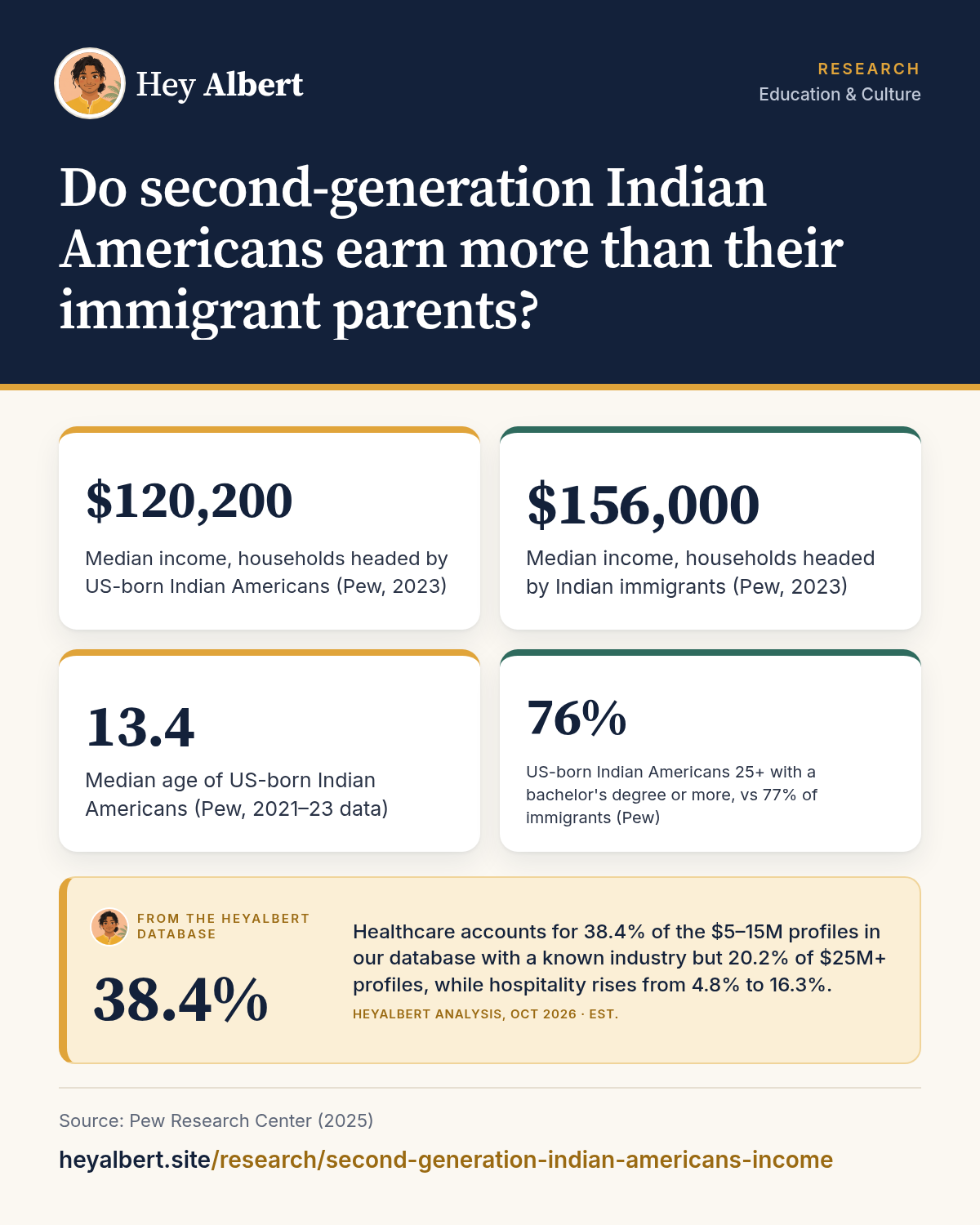
Not yet, on raw numbers: in 2023 households headed by US-born Indian Americans had a median income of $120,200, against $156,000 for immigrant-headed households, according to Pew Research Center1. But the comparison mostly reflects age, since the median US-born Indian American is 13.4 years old1. Research tracking parents and children at the same income level finds children of Indian immigrants reach higher income ranks than children of US-born parents2.
HeyAlbert data shows healthcare accounts for 38.4% of the $5–15M profiles in our database with a known industry but 20.2% of $25M+ profiles, while hospitality rises from 4.8% to 16.3%. See the data · Methodology
The raw comparison
Pew Research Center's 2025 fact sheet, based on 2021–23 American Community Survey data, reports that households headed by an Indian immigrant had a median income of $156,000 in 2023, while those headed by a US-born Indian American had $120,2001. Both are far above the national median, but on its face the second generation earns less.
That reading is misleading, because the two groups are at different stages of life. The median age of US-born Indian Americans was 13.4, compared with 40.9 for immigrants, and six in ten US-born Indian Americans were under 181. The US-born household heads in these figures are disproportionately in their 20s and early 30s, early in careers that typically peak in the 40s and 50s. We set out the immigrant and US-born profiles side by side in foreign-born versus US-born Indian Americans.
What HeyAlbert data shows
What the mobility research shows
A better test compares children with their own parents. Economists Ran Abramitzky, Leah Platt Boustan, Elisa Jácome and Santiago Pérez studied income mobility for immigrant families over more than a century, using administrative data on millions of parent–child pairs for the modern period2. They found that children of immigrants generally reach higher income ranks than children of US-born parents who grew up at the same income level, and among today's origin countries they identify India and China as groups whose children did better than the children of the US-born2. Across all immigrant groups, children whose parents were at the 25th percentile of the income distribution went on to rank 3 to 6 percentile points higher than children of US-born parents at the same starting point5. The researchers also find that much of this advantage comes from where immigrant families settle: they tend to choose places where children have good economic prospects5.
The same paper notes that Indian immigrants themselves out-earn US-born workers on average2, so their children start from a high base. Even so, the evidence points to the second generation holding or improving on their parents' position rather than slipping back.
Education carries across generations
The clearest sign of continuity is education. Pew found that 76% of US-born Indian Americans aged 25 and over held at least a bachelor's degree, nearly identical to the 77% of immigrants1. That is roughly double the national rate of 36.8% in 20244. Since degrees are the strongest predictor of earnings in the US, the second generation is positioned to reach high incomes as it ages. Our article on Indian American education levels has the full figures.
Different paths to wealth
The first generation's wealth was built heavily through skilled-worker immigration into technology, medicine and engineering, as we describe in why Indian Americans are wealthier than average and the H-1B visa and Indian American wealth. The second generation grows up with US credentials, networks and often family capital from the start. Public data does not yet show which industries second-generation Indian Americans favor at the top of the income scale, but as US citizens by birth they enter the workforce without the visa conditions that shaped many of their parents' early careers.
Family wealth also matters. Many second-generation Indian Americans will receive help with education, home purchases or business ventures, and eventually inheritances; see what the coming wealth transfer means for Indian American families.
Marriage, homeownership and household income
Household income depends on household structure, and here too age shapes the numbers. Pew found 35% of US-born Indian American adults were married, against 77% of immigrants, and homeownership was 54% for US-born household heads versus 63% for immigrant heads1. Single young adults naturally have lower household incomes than married couples in mid-career. As the second generation marries and forms households, its median household income is likely to rise, though that is a projection rather than a measured fact.
The size of the second generation
In 2024, about 1.57 million people who identified as Asian Indian alone were born in the US, and the group included about 1.1 million children under 183. Pew's broader count of Indian Americans grew from 470,000 US-born in 2000 to 1.65 million in 20231. Over the next decade a large share of this group will move into the labor market, which will reshape the community's income profile. We look at that outlook in how Indian American wealth may change over the next decade.
Frequently asked questions
Do second-generation Indian Americans earn more than first-generation?
Not in raw household income yet, because most US-born Indian Americans are still young. Research comparing children with parents at the same income level finds children of Indian immigrants reach higher income ranks than children of US-born parents.
What is the median income of US-born Indian American households?
Pew Research Center reported $120,200 for households headed by a US-born Indian American in 2023, compared with $156,000 for immigrant-headed households.
Are second-generation Indian Americans as educated as their parents?
Yes. Pew found 76% of US-born Indian Americans aged 25 and older held at least a bachelor's degree, almost the same as the 77% of immigrants.
How many US-born Indian Americans are there?
About 1.57 million people identifying as Asian Indian alone were born in the US as of 2024, many of them children.
Sources
Figures are from the public sources below, with the data year stated. Estimates are labeled as estimates. Accessed October 24, 2026.
- Pew Research Center, Facts about Indians in the U.S. (2025). pewresearch.org ↩ ↩ ↩
- National Bureau of Economic Research, Intergenerational Mobility of Immigrants in the US over Two Centuries (NBER Working Paper 26408) (2019). nber.org ↩ ↩ ↩
- U.S. Census Bureau, Selected Population Profile in the United States (S0201): Asian Indian alone, 2024 ACS 1-year estimates (2025). data.census.gov ↩ ↩
- U.S. Census Bureau, Selected Population Profile in the United States (S0201): Total population, 2024 ACS 1-year estimates (2025). data.census.gov ↩
- National Bureau of Economic Research (The Digest), Income Mobility in the Families of Immigrants and US Natives (2020). nber.org ↩ ↩