
Short answer
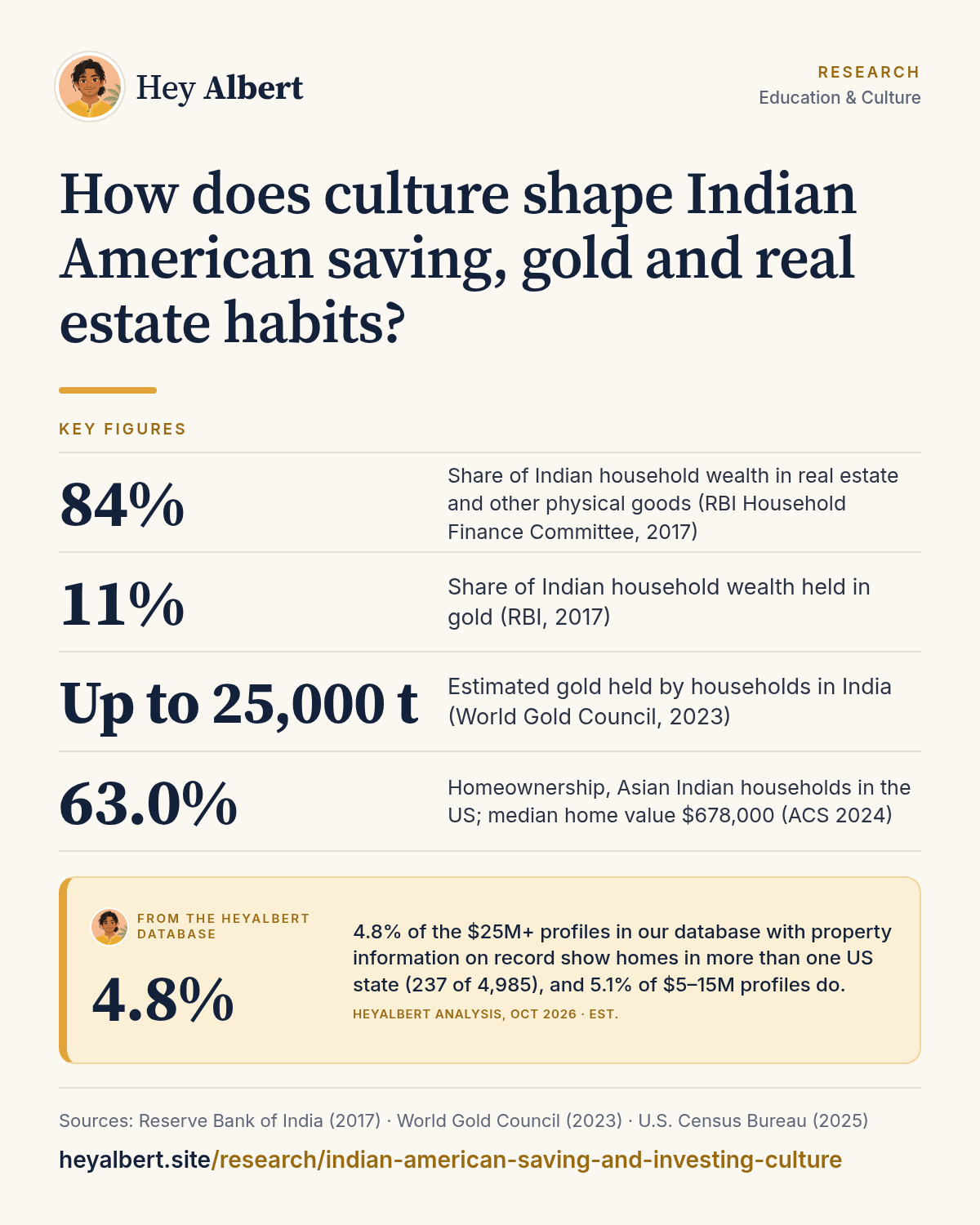
In India itself, households keep most of their wealth in physical assets: an RBI committee found the average household held 84% of its wealth in real estate and other physical goods, 11% in gold and only 5% in financial assets1, and the World Gold Council estimates Indian households hold up to 25,000 tonnes of gold2. Indian Americans live in a different financial system, and the US data shows high homeownership in expensive markets, with little evidence that the India-style tilt to gold carries over at scale3,4.
HeyAlbert data shows 4.8% of the $25M+ profiles in our database with property information on record show homes in more than one US state (237 of 4,985), and 5.1% of $5–15M profiles do. See the data · Methodology
Start with India: physical assets dominate
Questions about Indian American attitudes to gold and property often begin with what is true in India. The Reserve Bank of India's Household Finance Committee, reporting in 2017, found that the average Indian household held 84% of its wealth in real estate and other physical goods, 11% in gold and just 5% in financial assets such as deposits, shares, mutual funds, insurance and retirement accounts1. The committee noted that retirement accounts played a very limited role even at the top of the wealth distribution1.
Gold holdings are vast. The World Gold Council, in a 2023 report, estimated that Indian households hold up to 25,000 tonnes of gold2. Gold plays roles in weddings, gifts and family security as well as investment, and real estate is the main store of family wealth.
What HeyAlbert data shows
Indian Americans live in a different system
Those patterns reflect India's financial system, in which, the RBI committee found, retirement accounts play a limited role and many households continue to accumulate debt as they approach retirement age1. Indian Americans live with US employer retirement plans, deep stock markets, easy access to mortgages and, for many tech workers, stock-based pay. The available US evidence suggests their balance sheets look much more American than Indian.
The Urban Institute's analysis of the Federal Reserve's 2022 Survey of Consumer Finances found that Asian American families, of whom Asian Indians are one of the two largest groups, have financial portfolios broadly similar to white families, with substantial variation4. For context, the Federal Reserve's 2025 survey found that 56% of all US families held stocks directly or indirectly, for example through retirement accounts, and that among those who did, median holdings were $77,4008. Equity compensation in particular has become a major source of wealth for executives and engineers; see how equity compensation drives Indian American wealth.
Real estate: a strong preference that does carry over
Homeownership is one habit that does show up clearly. In 2024, 63.0% of Asian Indian households in the US owned their home, roughly in line with the national 65.3% despite a much younger population, and the median value of those homes was $678,000, nearly double the national $360,6003,6. Asian Indian owners with a mortgage had median monthly costs of $3,603, versus $2,035 nationally3,6. Pew found homeownership was higher for households headed by Indian immigrants (63%) than by US-born Indian Americans (54%)7, though that partly reflects age.
The Urban Institute also found that 97% of Asian American families' debt was mortgages or student loans, debt generally seen as "productive"4. For property as an investment beyond the family home, see Indian American real estate developers, and for property in India, do Indian Americans own property in India.
Gold: tradition more than portfolio
We found no reliable survey measuring how much gold Indian American households hold. Gold jewelry remains central to weddings and family gifts in the diaspora, as covered in Indian American wedding spending, but there is no public evidence that gold makes up anything like the 11% share of wealth seen in India. Any claim about Indian Americans' gold holdings in percentage terms should be treated with caution.
Saving for family, here and in India
Another cultural pattern is financial ties to family in India. The US is now the largest source of remittances to India: it accounted for 27.7% of India's inward remittances in 2023-24, up from 23.4% in 2020-21, according to the RBI, out of total remittances of $118.7 billion that year5. Not all of that comes from Indian Americans, but much of it reflects support for parents and relatives and investment in India. See how much Indian Americans send to India.
Shared households are a further channel: Indian American homes are more likely than average to include the householder's parents, which lets families pool costs and savings; see multigenerational living and household wealth.
Avoiding the stereotype
Saving behavior is shaped far more by income, age, education and the financial system people live in than by culture alone. Indian Americans are a young, highly educated, high-income group, which predicts high saving and investment rates for anyone. The cultural preferences for property and gold that are well documented in India appear in softened form in the diaspora, and the evidence for specific percentages is thin. For a data-led look at investment patterns, see how Indian Americans invest their wealth.
Frequently asked questions
Do Indian Americans invest heavily in gold?
There is no reliable data on Indian American gold holdings. In India, gold makes up about 11 percent of household wealth, but US-based households appear to hold most wealth in homes, retirement accounts and stocks.
How much gold do Indian households hold?
The World Gold Council estimates that households in India hold up to 25,000 tonnes of gold.
Do Indian Americans prefer real estate?
Homeownership is common and in high-value markets: 63 percent of Asian Indian households owned their home in 2024, with a median value of 678,000 dollars.
How much money is sent from the US to India?
The US accounted for 27.7 percent of India's inward remittances in 2023-24, the largest share of any country, according to the Reserve Bank of India.
Sources
Figures are from the public sources below, with the data year stated. Estimates are labeled as estimates. Accessed October 24, 2026.
- Reserve Bank of India, Report of the Household Finance Committee (2017). rbi.org.in ↩ ↩ ↩
- World Gold Council, Gold investment market and financialisation: India gold market series (2023). gold.org ↩ ↩ ↩
- U.S. Census Bureau, Selected Population Profile in the United States (S0201): Asian Indian alone, 2024 ACS 1-year estimates (2025). data.census.gov ↩ ↩ ↩
- Urban Institute, A Snapshot of Asian Wealth in America (2025). apps.urban.org ↩ ↩ ↩
- Reserve Bank of India, Changing Dynamics of India's Remittances – Insights from the Sixth Round of India's Remittances Survey (2025). rbi.org.in ↩ ↩
- U.S. Census Bureau, Selected Population Profile in the United States (S0201): Total population, 2024 ACS 1-year estimates (2025). data.census.gov ↩ ↩
- Pew Research Center, Facts about Indians in the U.S. (2025). pewresearch.org ↩
- Federal Reserve Board, Federal Reserve Board releases results of the 2025 Survey of Consumer Finances (2026). federalreserve.gov ↩