
Short answer
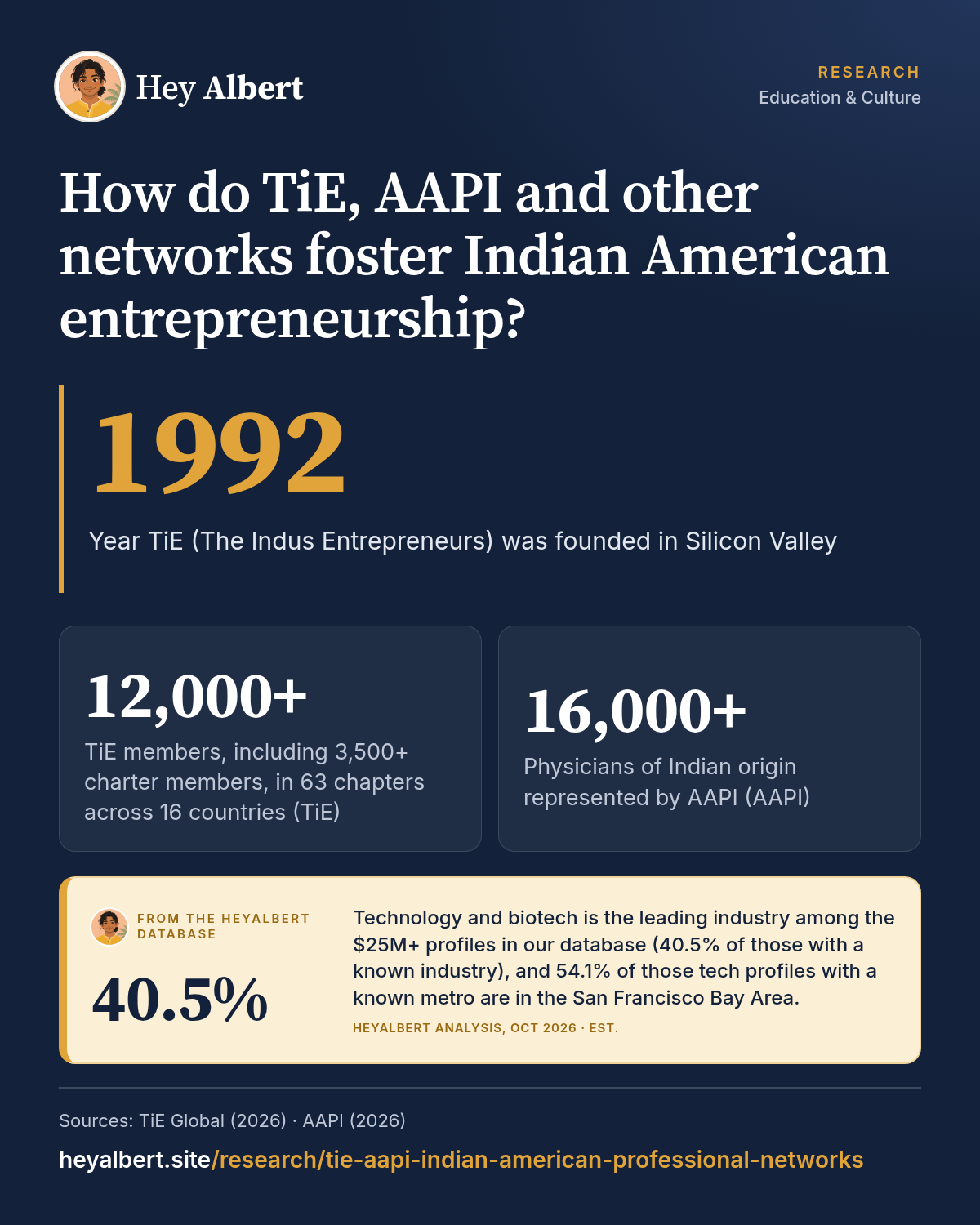
Professional networks give Indian Americans mentoring, capital and political voice. TiE, founded in Silicon Valley in 1992, reports more than 12,000 members in 63 chapters across 16 countries1; the American Association of Physicians of Indian Origin (AAPI) describes itself as the voice of more than 16,000 physicians4; and the Asian American Hotel Owners Association (AAHOA) represents about 20,000 hotel owners5. Each turns a shared background into deal flow, advice and advocacy.
HeyAlbert data shows technology and biotech is the leading industry among the $25M+ profiles in our database (40.5% of those with a known industry), and 54.1% of those tech profiles with a known metro are in the San Francisco Bay Area. See the data · Methodology
Why networks matter for wealth creation
Starting a company or buying a business takes more than skill. It takes introductions, advice from people who have done it before, and access to capital. For immigrants arriving without family connections in the US, organized networks fill that gap. Indian Americans built several influential ones, each tied to a sector where the community is heavily represented: technology, medicine and hospitality. They help explain how high incomes, described in why Indian Americans are wealthier than average, turned into business ownership and equity wealth.
What HeyAlbert data shows
TiE: entrepreneurs helping entrepreneurs
The Indus Entrepreneurs (TiE) was founded in 1992 in Silicon Valley by a group of entrepreneurs, corporate executives and senior professionals with roots in the Indus region1. Its stated mission is to foster entrepreneurship through five pillars: mentoring, networking, education, funding and incubation1. TiE reports more than 12,000 members, including over 3,500 charter members who serve as mentors, in 63 chapters across 16 countries1. Its flagship event, TiEcon, is billed by the organization as the largest professional conference for entrepreneurs1. Alongside it, TiE runs special interest groups, deal-flow meetings, a TiE Young Entrepreneurs program for young people, and a TiE Women's Forum and CEO Forum1, so the network reaches people at every stage, from young people to seasoned chief executives.
The founding Silicon Valley chapter says it has supported 25,000 entrepreneurs and helped create more than 2 million jobs worldwide2; those are the organization's own figures. The model is simple: successful founders mentor the next generation, then often invest in them. We cover the startups that came out of this ecosystem in Indian American tech founders and unicorns and startups founded by Indian immigrants.
TiE Angels: turning mentorship into capital
TiE Angels, run out of TiE Silicon Valley, invests in seed and Series A rounds of companies with a strong value proposition, business plan and team3. All members must be accredited investors under SEC Rule 501, and TiE Silicon Valley charter members can join at no extra cost, while others pay a $250 annual membership fee3. The group is managed by its members3. Angel groups like this let successful founders and executives recycle their wealth into new companies, often with a hands-on mentoring role. For more on this, see Indian American angel investors and TiE Angels and Indian American venture capitalists.
AAPI: the physicians' network
The American Association of Physicians of Indian Origin (AAPI) describes itself as the united voice of more than 16,000 physicians of Indian origin across the United States4. Its programs span policy advocacy, continuing medical education, global health initiatives, a young physicians section and a women's leadership initiative4. Beyond advocacy, networks like AAPI connect doctors who often go on to own practices, surgery centers and other health care businesses. See how many US doctors are Indian American for the profession's scale.
AAHOA: the hotel owners
The Asian American Hotel Owners Association (AAHOA) represents about 20,000 hotel owners and states that its members own 60% of American hotels and contribute $371.4 billion to US GDP5. These are the association's own figures. The network effect here predates the association itself. National Geographic reported in 2018 that about half of US motels were owned by Indian Americans, a majority of them from Gujarat's Patel community, and described how early owners encouraged new arrivals to lease hotels and extended "handshake loans" with no collateral and no fixed repayment schedule8. Families often lived in the properties and ran them themselves8. Community finance and shared know-how let the model spread from one family to the next. We tell that story in why Patels own so many motels.
Diaspora-wide networks
Other organizations work across sectors. Indiaspora, a nonprofit of diaspora leaders, commissioned a 2024 Boston Consulting Group report that estimated Indians had co-founded 72 of the 648 US unicorns operating that year6,7. Alumni networks of Indian universities, professional associations and community foundations also connect people, while giving circles channel wealth into philanthropy; see Indian American philanthropy.
What networks can and cannot explain
Networks amplify advantages people already have. They work best for those with the education and capital to use them, which is one reason outcomes within the community vary widely. Membership figures are self-reported by each organization and are not independently audited, so they are best read as indicators of scale rather than precise counts.
Frequently asked questions
What is TiE?
TiE, The Indus Entrepreneurs, is a nonprofit founded in Silicon Valley in 1992 to foster entrepreneurship through mentoring, networking, education, funding and incubation. It reports more than 12,000 members in 63 chapters across 16 countries.
What is AAPI?
The American Association of Physicians of Indian Origin, which describes itself as the united voice of more than 16,000 physicians of Indian origin in the United States.
Who can join TiE Angels?
Accredited investors. TiE Silicon Valley charter members join at no extra charge, and others pay a 250 dollar annual membership fee, according to TiE Angels.
What share of US hotels do AAHOA members own?
AAHOA says its roughly 20,000 members own 60 percent of American hotels. That is the association's own figure.
Sources
Figures are from the public sources below, with the data year stated. Estimates are labeled as estimates. Accessed October 24, 2026.
- TiE Global, About TiE (2026). tie.org ↩ ↩ ↩
- TiE Silicon Valley, TiE Silicon Valley (2026). tiesv.ai ↩
- TiE Angels, Become an Investor (2026). tieangels.com ↩ ↩ ↩
- AAPI, American Association of Physicians of Indian Origin (home page) (2026). aapiusa.org ↩ ↩ ↩
- AAHOA, AAHOA: The Foremost Resource and Advocate for America's Hotel Owners (2026). aahoa.com ↩ ↩ ↩
- Indiaspora, Indiaspora Releases Report on Impact of Indian Diaspora in America (press release, GlobeNewswire) (2024). finance.yahoo.com ↩
- The Hindu BusinessLine, Indian Americans pay 5-6% of income taxes in the US, report says (2024). thehindubusinessline.com ↩
- National Geographic, How Indian Americans Came to Run Half of All U.S. Motels (2018). nationalgeographic.com ↩ ↩