
Short answer
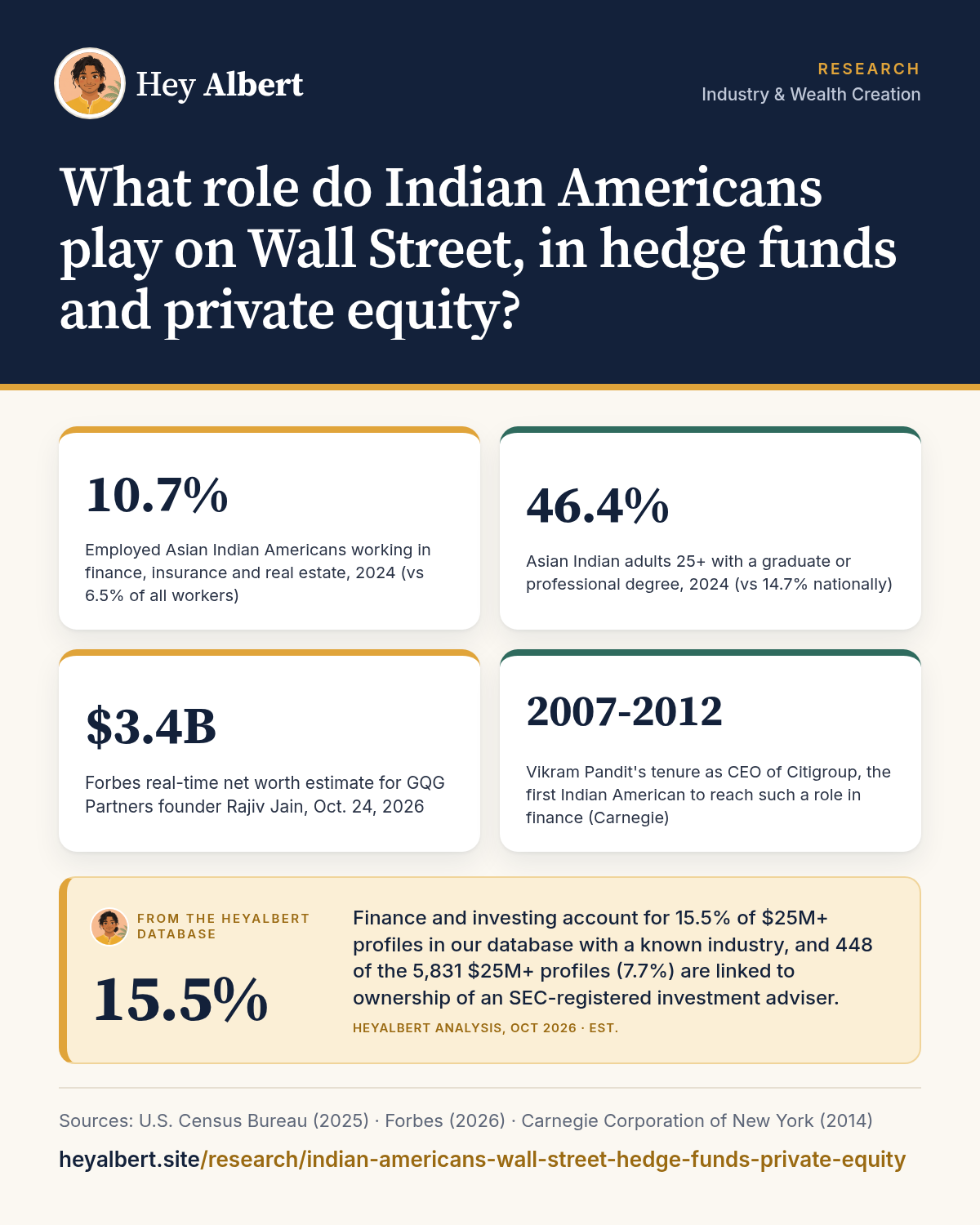
Indian Americans are well represented in US finance: in 2024, 10.7% of employed Asian Indian Americans worked in finance, insurance and real estate, against 6.5% of all US workers, according to the Census Bureau1. At the top, Indian-born leaders have run Citigroup (Vikram Pandit) and Mastercard (Ajay Banga), and asset manager Rajiv Jain, founder of GQG Partners, has a Forbes-estimated net worth of $3.4 billion2,3,4.
HeyAlbert data shows finance and investing account for 15.5% of $25M+ profiles in our database with a known industry, and 448 of the 5,831 $25M+ profiles (7.7%) are linked to ownership of an SEC-registered investment adviser. See the data · Methodology
What the data show
No official source counts Indian Americans by job title on Wall Street, at hedge funds or in private equity. The Census Bureau's American Community Survey does report the industries people work in, and it shows a clear tilt toward finance. In 2024, 10.7% of employed people who identify as Asian Indian alone worked in finance and insurance or real estate, compared with 6.5% of all US workers1. The same survey shows 46.4% of Asian Indian adults aged 25 and older held a graduate or professional degree, against 14.7% of all US adults1, a credential profile that matches the MBA- and PhD-heavy recruiting of investment banks and asset managers.
| ACS 2024 (1-year) | Asian Indian alone | All US |
|---|---|---|
| Employed in finance, insurance and real estate | 10.7% | 6.5% |
| In management, business, science and arts occupations | 75.7% | 43.5% |
| Graduate or professional degree (age 25+) | 46.4% | 14.7% |
Source: US Census Bureau, ACS 2024 1-year, S02011. Three in four employed Asian Indian Americans work in management, business, science and arts occupations1. For the education picture, see Indian American education levels.
What HeyAlbert data shows
Leaders at the top of finance
Several Indian-born executives have led major US financial institutions. These examples come from public biographies:
- Vikram Pandit served as CEO of Citigroup from 2007 to 2012, steering the bank through the global financial crisis; the Carnegie Corporation describes him as the first Indian American to reach such heights in finance. He previously held senior leadership roles at Morgan Stanley and holds a PhD in finance from Columbia University3.
- Ajay Banga was president and CEO of Mastercard for 12 years, after a career that included Citigroup's Asia-Pacific business, and later vice chairman at the private equity firm General Atlantic. In June 2023 he became president of the World Bank Group, the first Indian American to lead it2,5.
- Rajiv Jain, born in India, came to the US in the early 1990s for an MBA, rose to co-CEO of Vontobel Asset Management and in 2016 co-founded GQG Partners, which listed in Australia in 2021. Forbes estimates his net worth at $3.4 billion as of October 24, 20264.
Corporate leadership more broadly is covered in Indian American Fortune 500 CEOs and pay in the net worth and pay of Indian American CEOs.
How wealth is built in finance
Finance creates wealth through a few distinct channels. Bankers and traders earn high salaries and bonuses, often paid partly in deferred stock. Senior executives at public financial companies accumulate equity over long tenures, the same mechanism explained in how equity compensation drives Indian American wealth. Founders of asset managers, hedge funds and private equity firms earn a share of management fees and performance fees and own equity in the management company itself; Rajiv Jain's fortune, which Forbes attributes to finance and lists as self-made, reflects ownership of a firm he co-founded4.
Finance careers also shape how families manage money. Professionals who spend their working lives evaluating investments often bring that discipline home, with concentrated stock awards, private-fund interests and real estate that need careful diversification and tax planning. Those patterns are explored in how Indian Americans invest their wealth.
Private equity and venture capital overlap: both raise pooled funds from institutions and wealthy families and share in profits. Indian Americans' prominence in venture capital is profiled in Indian American venture capitalists.
Cross-border capital
Many Indian American finance professionals act as a bridge between US capital and India's fast-growing markets. Forbes notes, for example, that GQG invested $1.9 billion in four companies in India in 20234. That cross-border expertise is increasingly valuable to wealthy families who hold assets in both countries, a theme covered in whether wealthy Indian Americans keep property in India and cross-border tax planning.
Caveats
The industry figures above combine finance, insurance and real estate, and include clerical and sales roles as well as investment professionals1. There is no reliable public count of Indian American partners at hedge funds or private equity firms, or of managing partners at venture firms; figures circulating online without a cited data source should be treated with caution. The individuals named here are examples from public profiles, not a ranking, and many other Indian Americans hold senior roles at banks, insurers, hedge funds and private equity firms without public profiles of this kind.
Frequently asked questions
Are many Indian Americans on Wall Street?
Census data show Indian Americans are overrepresented in finance: 10.7% of employed Asian Indian Americans worked in finance, insurance and real estate in 2024, versus 6.5% of all US workers. There is no official count of Indian Americans at specific banks or funds.
Who was the first Indian American CEO of a major US bank?
Vikram Pandit, who led Citigroup from 2007 to 2012, is described by the Carnegie Corporation as the first Indian American to reach such heights in the financial world.
Who are prominent Indian American asset managers?
One example is Rajiv Jain, co-founder of GQG Partners, whom Forbes lists as a self-made billionaire with an estimated net worth of $3.4 billion as of October 2026.
How do hedge fund and private equity founders make money?
They earn management fees on assets, a share of investment profits, and returns on owning the management firm and investing their own capital in its funds.
Sources
Figures are from the public sources below, with the data year stated. Estimates are labeled as estimates. Accessed October 24, 2026.
- US Census Bureau, American Community Survey 2024 1-year, Selected Population Profile (S0201), Asian Indian alone (2025). data.census.gov ↩ ↩ ↩
- Carnegie Corporation of New York, Ajay Banga (Great Immigrants 2023) (2023). carnegie.org ↩ ↩ ↩
- Carnegie Corporation of New York, Vikram S. Pandit (Great Immigrants 2008, updated 2014) (2014). carnegie.org ↩ ↩ ↩
- Forbes, Rajiv Jain (profile) (2026). forbes.com ↩ ↩ ↩
- World Bank Group, Ajay Banga, President (leadership biography) (2026). worldbank.org ↩